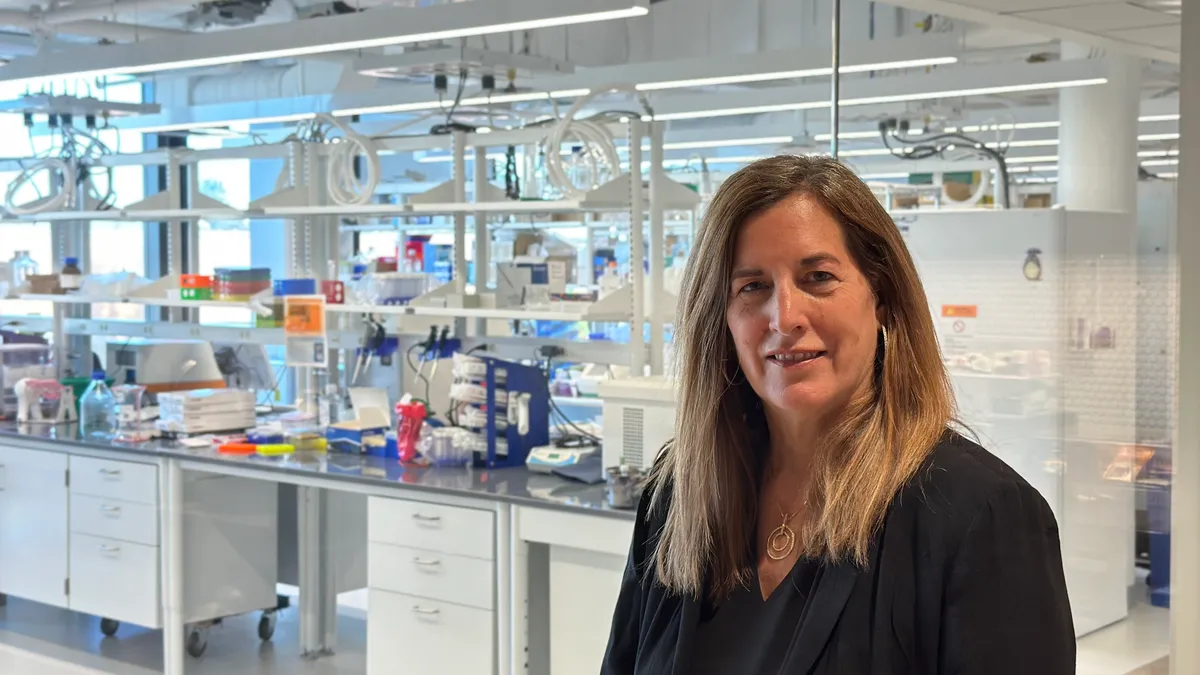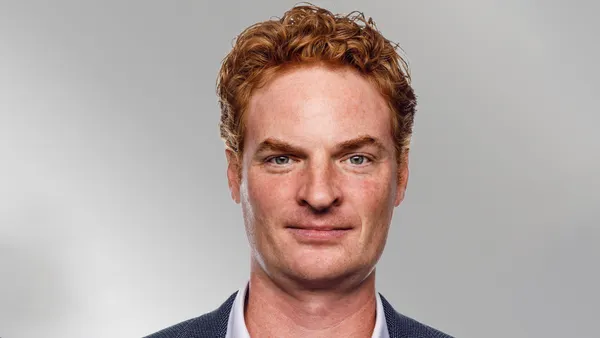
Welcome to First 90 Days, a series dedicated to examining how pharma executives are planning for success in their new roles. Today, we’re in conversation with Karen Massey, the new CEO of Argenx, who’s aiming for a broad autoimmune disease R&D strategy leveraging first-in-class biology.
Argenx has all the trappings of a well-oiled corporation.
Its flagship autoimmune disease drug Vyvgart posted over $2.8 billion in sales during the first half of 2026 — a more than 60% jump over last year. Argenx also recently flexed its dealmaking muscles, completing its $2.2 billion acquisition of Forte Biosciences. And with a market cap that’s hovered above $50 billion for the majority of this year, the Netherlands-based company is one of the most valuable biotechs in Europe.
But behind the scenes, there’s something a little punk rock going on.
Rather than structuring the work flow in a traditional top-down approach split between drug development departments, Argenx has its own system. Teams doing different drug R&D or commercialization functions that might be typically siloed are instead brought together to work under specific indication areas.
It’s a strategy that is “very actively fighting against the hierarchy and bureaucracy” often found at big companies, according to its new CEO, Karen Massey. It’s also created the kind of environment that will help Argenx tackle a perennial problem in biotech: keeping the entrepreneurial spirit and agility of a startup as the company scales into a larger enterprise, Massey said.
So far, Vyvgart is Argenx’s only approved product, but it’s been a runaway success. A first-of-its-kind drug that blocks a receptor called FcRn, Vyvgart works by reducing levels of harmful immunoglobulin G antibodies in the body. And because Vyvgart targets this broad process rather than a specific disease, it has far-reaching potential in the autoimmune space.
The drug notched its first FDA approval in 2021 for generalized myasthenia gravis and has since been OK’d in other formulations and for one other disease. With the treatment in the clinic for seven other indications, including Graves’ disease and ocular myasthenia gravis, its reach could expand.
Earlier this month, Argenx released positive phase 3 results for Vyvgart in autoimmune myositis, teeing up a potential approval in another blockbuster disease area.
As these new successes roll in, Argenx is still mostly “known as a Vyvgart story,” Massey said, and in the short term, that’s not likely to change.
Argenx has big plans for Vyvgart not only as a monotherapy, but as a potential backbone drug that can be combined with a range of treatments — much like how Keytruda is used in cancer.
But Argenx is also stacking its pipeline with candidates that take aim at autoimmune conditions through other novel targets, including its potential first-in-class antibody that binds to muscle-specific kinase. All told, the company plans to have at least 10 immunology candidates in clinical development by the end of the year.
Massey was appointed CEO in May as part of a planned transition after one of Argenx’s co-founders, Tim Van Hauwermeiren, stepped into the chair position on the company’s board.
“A number of stars aligned. And because the company is in such a position of strength, it was the right moment to make the change smoothly,” said Massey, who came aboard Argenx as the chief operating officer in 2023.
Here, Massey explains what she’s bringing to the gig, how she plans to keep Argenx’s biotech spirit alive and what’s next for Vyvgart and the company’s broader pipeline.
This interview has been edited for brevity and style.
PHARMAVOICE: Tell me about your development strategy for Vyvgart. How is it similar to Keytruda? How do you plan to innovate beyond it?
KAREN MASSEY: Vyvgart is an incredibly special asset. Similar to Keytruda, it's a once-in-a-generation asset that acts as a backbone therapy that allows us to build on it. There are about 100 different indications or diseases you could potentially treat with Vyvgart, and so we're continuously exploring where it could have an impact for patients.
We're at about 15 indications that we're studying or that we will be studying with Vyvgart, and by having next-generation FcRn molecules — ARGX-213 and ARGX-124 — it allows us to expand that number of indications even further.
Our vision for 2030 is that we want to be treating 50,000 patients in 10 different approved indications. So we’ve grounded our corporate goals in our purpose, which is patients, treating diseases and advancing science.
When you have this kind of superstar drug, how does that impact your deal-making strategy?
Our strategy in general is that we're not just an FcRn company. Our goal is to become an immunology innovator and transform the lives of immunology patients more broadly. So we have a very deep pipeline with very cool, novel science, and a lot of molecules that are coming out of our pipeline. In addition to that, we also look at science coming out of biotechs and academia. But we're agnostic about the source. It's focused on where the novel biology is that can transform the lives of patients suffering from autoimmune diseases.
What unique take are you bringing to the CEO role at Argenx?
My background is that I started in commercial and then moved into development. So I've been really able to integrate science and patients or science and the commercial engine, and I think my background gives the breadth I need to see those connections, and create an organization that brings those connections to life.
The secret behind our innovation agenda is that we're not stuck in this world where the people that are looking for new science are disconnected from the people that are working with patients. For us, it's about working as one team.
The shorthand I always use is: Innovation is defined as something that is both new and useful. And we bring both of those things together.
Is there anything keeping you up at night now that you’re in this role?
I sleep pretty well. But the one thing that's on my mind is that as Argenx grows and scales our impact, we're getting bigger as a company. We're having more impact, and that's great. That's good for patients, and it gives us the potential to explore more science. But I'm very aware of what goes wrong at this stage of scaling a biotech company, and I think there's a couple of things.
One is that you become arrogant and think that everything that got you to where you are today, all of those things will get you to where you need to be tomorrow. So we have a cultural pillar of humility, of being a learning organization and a humble organization. I'm really focused as CEO on maintaining that sense of curiosity, that sense of learning.
The second thing that gets in the way is bureaucracy, red tape and silos. And all of that creeps in as biotechs grow, and the next thing you know, you wake up and you're a little pharma company. We know that the innovation output from pharma companies is less, and that's really what we're trying to avoid. So I’m very focused on maintaining what we call “the Argenx way,” which is our way of working. We see it as a competitive advantage that allows us to move faster and to keep innovating.
Biotechs and pharma companies of all sizes are now using AI for a variety of tasks. Do you have a favorite use case for yourself or for the company?
I'm not a power user, but I do use it every day. I have an agent set up that I find helpful as CEO to get much more integrated data. I can get it fed to me in a way that integrates our internal perspectives, our external perspectives and allows me to be more efficient in how I work.
For our strategic planning process, we also do these quarterly reviews. And we don't want to just track if we’re on budget because that just tells you that you spent money. We want to know if we used our forecast well or not.
We also like to see our innovation projects moving forward, and we’re now able to set up a dashboard that covers all the information based on emails or whatever the teams are doing. What's the progress on our innovation agenda over the last quarter? We can see things moving. And it's without a bunch of overhead and people who are doing annoying work entering their status updates. It's just pulling it, and so that allows us as a management team to say, "Where are we doing well? Where are our teams getting stuck? How can we help?” I think that's pretty cool.