America's leading pharma trade group is suing the Trump administration over drug pricing policies. On Oct. 7, the Pharmaceutical Research and Manufacturers of America, or PhRMA, challenged a new Medicare policy tying some U.S. drug payments to prices abroad.
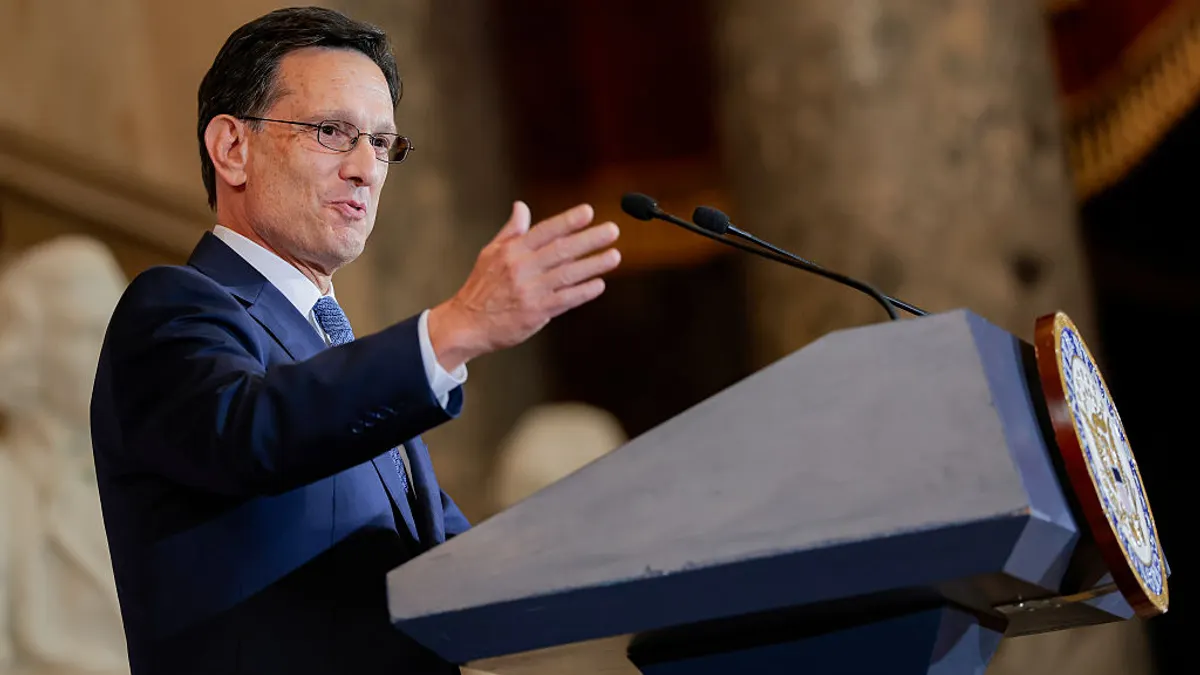
Eight days earlier, the trade group had named Eric Cantor, a former GOP House leader, as its next president and CEO. He takes over Nov. 9, six days after the midterm elections.
Cantor brings years of experience in Congress, while PhRMA's lawsuit challenges the authority of a Republican White House.
The industry needs ways to navigate all those angles as lawmakers in both parties face pressure to bring down drug costs.
Pharma has long cultivated relationships across party lines. The question going into next week’s midterm elections and the remainder of the second Trump administration is what those connections can accomplish when both parties see political value in confronting prescription drug costs — and when some of the industry's biggest fights aren't confined to Capitol Hill.
The money and the policy fights
PhRMA reported $26.61 million in federal lobbying expenses during the first nine months of 2026, according to its disclosure filings for the first three quarters of the year. That was down nearly 10% from the $29.49 million it reported during the same period in 2025, when Congress debated the One Big Beautiful Bill Act, a sweeping tax-and-spending package signed into law in July.
The filings list Medicare drug-price negotiation, international price benchmarks and pharmacy benefit manager reform among the issues the group lobbied on, but do not break out spending by issue.
The group's political action committee, however, operates on a different scale. PhRMA's Better Government Committee reported $486,750 in contributions to other federal political committees from the start of the 2025–2026 cycle through Oct. 14, according to the Federal Election Commission.
Lobbying and campaign contributions aren't interchangeable. The former covers PhRMA's advocacy spending; the latter records its PAC's political disbursements. Neither figure represents the industry's total spending, much less prove that a payment changed a lawmaker's position.
PharmaVoice's review of the 2024 election found drug company PACs giving to congressional candidates in both parties. But a trade-group PAC total, even with the latest filings, doesn’t reveal whether manufacturers as a group have shifted their allegiances this year.
And there's another recent wrinkle to understanding which parties pharma is donating to this election cycle: The latest campaign-finance disclosures faced a temporary disruption. The FEC's electronic filing system went offline Oct. 26 amid reported hacking attempts, interrupting mandatory 24- and 48-hour reports in the final week before the election.
The agency restored electronic filing access on Oct. 28, but the interruption delayed public visibility into some late-cycle spending. Previously filed records remained searchable throughout.
But pharma’s interest in influencing policymaking stretches across administrations. On Jan. 1, the first prices negotiated under the Inflation Reduction Act took effect for 10 Medicare Part D drugs.
"[Manufacturers] are still more terrified of what the PBMs and their parent companies can do to them. More so than any political entity or person.”

Mark Cuban
Entrepreneur and CEO, Cost Plus Drugs
The program was created under then-President Joe Biden, but the Trump administration has kept it moving: In January, Medicare selected another round of medicines for negotiation, including Part B drugs for the first time. The resulting prices are set to take effect in 2028.
That continuing Medicare program is separate from President Donald Trump's most-favored-nation policies.
PhRMA's lawsuit challenges one of them, known as GLOBE, which would use international price benchmarks to calculate certain rebates on Medicare Part B drugs. PhRMA argues the administration exceeded Medicare's legal authority and could jeopardize investment in new treatments. The case has not been decided.
The industry is pressing lawmakers for favorable rules while fighting one part of a Republican administration's agenda in court. A different balance of power in Congress would not automatically unwind programs already taking effect.
The watchdog group Public Citizen told PharmaVoice that policymakers should allow Medicare to negotiate prices for all branded drugs and eliminate negotiation waiting periods and the orphan-drug exemption. The group argues that these restrictions allow manufacturers to set high prices for years without negotiation, undermining potential savings.
A common target, different interests
There’s another key player in the labyrinth that is the American healthcare system: pharmacy benefit managers.
PBMs negotiate drug coverage and rebates for insurers and health plans, giving them considerable leverage over which medicines are placed on formularies. Their controversial role in drug pricing has made them a target of lawmakers in both parties and critics in the business world.
In February, Trump signed bipartisan legislation that changes aspects of how PBMs will be compensated in Medicare Part D and requires greater transparency around rebates and contracting. The provisions will be phased in gradually, and in this case, PhRMA welcomed the change, with outgoing CEO Steve Ubl praising lawmakers' willingness to confront the intermediaries within the health system.
But transparency and compensation reform are not the same as breaking up the businesses themselves. A pair of strange bedfellows, Sens. Elizabeth Warren, D-Mass., and Josh Hawley, R-Mo., introduced a separate bill in February targeting certain forms of vertical integration among insurers, PBMs and medical businesses. It remains a proposal, not an enacted part of the February reforms.
Mark Cuban, whose Cost Plus Drugs business competes with established pharmacy distribution models, has argued that neither greater transparency nor changes to rebates will necessarily help smaller competitors obtain branded medicines at competitive wholesale prices.
In a LinkedIn post, Cuban recounted asking a branded-drug CEO how many lives his group purchasing organization would need to cover before the manufacturer would sell its branded medicines at competitive prices.
The reported answer: half the lives covered by the three largest PBMs. Otherwise, the manufacturer feared losing favorable placement on insurers' drug formularies, Cuban said.
Asked by PharmaVoice whether his discussions with manufacturers or wholesalers had become more productive, Cuban replied by email: “No. They are still more terrified of what the PBMs and their parent companies can do to them. More so than any political entity or person.”
Cost Plus Drugs would benefit commercially from better access to branded products. But the underlying concentration is well documented: A Federal Trade Commission inquiry found that the three largest PBMs handled nearly 80% of U.S. prescriptions in 2023.
FTC staff have also raised concerns about rebate arrangements involving PBMs and brand manufacturers that can disadvantage lower-cost competitors.
Drugmakers and Cuban can both support restrictions on PBMs without having the same commercial interests. Congress can change the rules governing intermediaries, but altering the bargaining relationships behind drug prices is another matter.
And Cantor will arrive six days after the election to lead a trade group suing a Republican White House, lobbying lawmakers in both parties and backing legislation aimed at pharmacy middlemen.
Winning allies in Congress still matters to drugmakers. But the fight over what medicines cost — and who controls access to them — extends well beyond the politicians receiving campaign checks going into next Tuesday's elections.