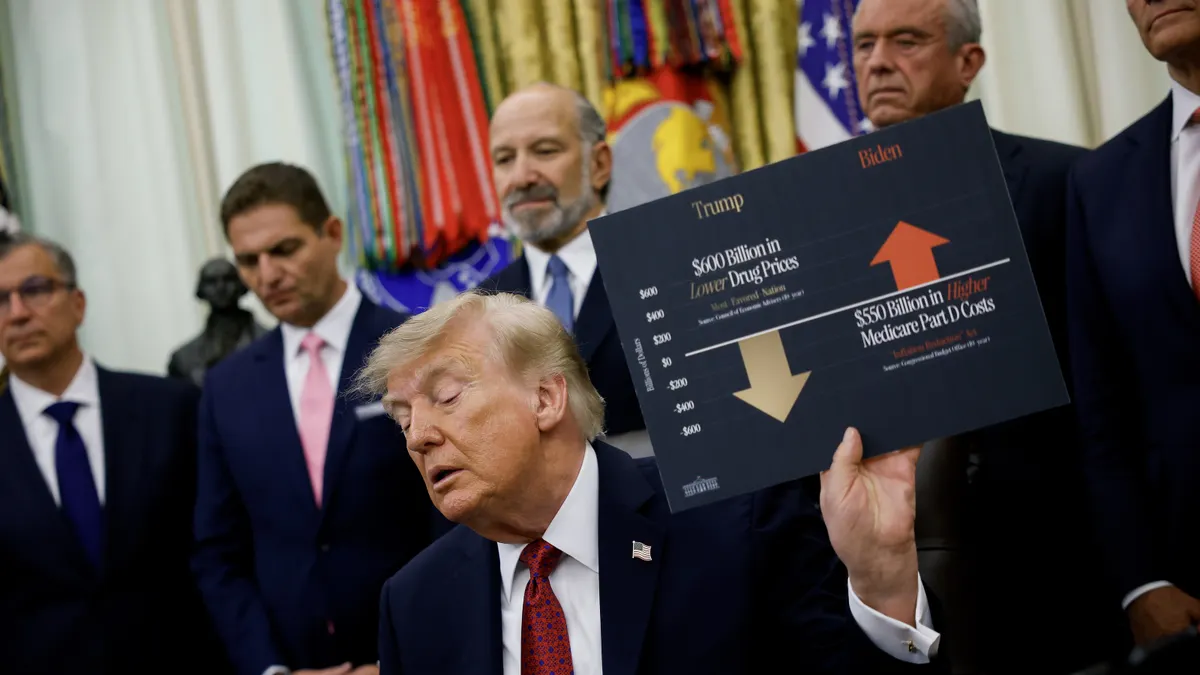
President Donald Trump’s various most-favored nation deals with pharma companies are purportedly intended to lower prices and slash federal drug spending. But the agreements could get in the way of other cost reduction plans that were in the works for the government. Specifically, the MFN deals could reduce projected Medicare savings by nearly 80%, according to an updated estimate from a Mass General Brigham study’s lead author.
Over the past year, the White House has announced MFN agreements with 26 pharma companies. The most recent batch included nine mid-size firms that the White House said would offer state Medicaid programs MFN drug prices tied to prices paid in other developed nations.
The White House also said the companies committed to apply MFN pricing to new medications and reduce prices on certain costly therapies. Some companies also said they’d contribute critical drugs to national stockpiles, or invest in U.S. manufacturing.
Typically, though, the deals’ exact details remain confidential and it's not clear yet how much additional savings the agreements will generate for Medicaid, which already gets steep drug discounts. And the Medicaid pricing commitments don’t directly set what commercial insurers (which cover the majority of Americans) pay for existing drugs.
But they could affect how much two separate proposed Medicare MFN payment models actually save.
The proposed models, Global Benchmark for Efficient Drug Pricing and Guarding U.S. Medicare Against Rising Drug Costs, were already developed to peg U.S. drug prices to various reference countries. Now, after striking agreements directly with the White House, some drugmakers believe they could be exempt from the Medicare models.
The plans to slash Medicare drug spend
The GLOBE Model for Medicare Part B and GUARD model for Medicare Part D were created following a May 2025 executive order directing federal health officials to bring American drug costs in line with pricing in other similar nations. Under the proposed rules, GLOBE would launch on Oct. 1 and GUARD on Jan. 1, 2027, but the plans have not been finalized.
Some experts say they could face legal challenges if implemented. As proposed, the programs would use drug prices in a group of similar countries as a reference point, which could save Medicare an estimated $11.6 billion a year in net drug spending in the models’ initial phase — a 16% to 18% reduction, according to a Lancet study.
So far, the federal government hasn’t said which companies that signed agreements will be exempt from GLOBE and GUARD. But some drugmakers have disclosed that they believe their agreements exempt them from the models, the study authors said.
“Our secondary analysis — looking at the impact on savings from exempting companies — was based on companies’ financial filings and other disclosures that they believe their agreements exempt them from GLOBE/GUARD,” said the Lancet study’s lead author, Dr. Thomas Hwang in an email.
That analysis estimates that excluding those companies from the models would eliminate a substantial portion of the projected savings.
Complexity may be a savings barrier
The potential GLOBE and GUARD exemptions aren’t the only complication in assessing whether the MFN agreements will lower Americans’ drug spending.
It’s not a straight line from manufacturer discounts to patient savings. The American healthcare system is a complex tangle of pre-existing agreements between manufacturers, insurers, pharmacy benefit managers and pharmacies that dictate drug prices, according to Paul Pruitt, chief growth officer of SHARx, a prescription advocacy and procurement program. Simply lowering a manufacturer’s price doesn’t necessarily mean patients will pay less.
“All of pharma seems to have these long-term contractual agreements with the government programs and the commercial markets, and they're all intertwined and interconnected in a very challenging way that is not easy to unwind,” he said.
Consumers stand to save through direct-to-consumer discounts, which patients can access through TrumpRx, Pruitt said. Some companies have signed on to sell their drugs at lower prices through TrumpRx as part of their agreements. But it’s not certain whether any of the most recent nine companies to ink deals will participate.
TrumpRx primarily offers cash-pay discounts outside traditional insurance, so it may provide less value to patients whose insurance already offers lower out-of-pocket prices.
Only a small number of branded prescription medicines are available through the platform. An NPR analysis found that 92 brand-name drugs were on TrumpRx as of mid-July, representing only 12% of the 800 brand-name drugs from participating companies. For example, Pfizer listed only 30 of its 178 branded drugs. In addition, some of the drugs on the site also have generic alternatives that may be less expensive.
Overall, some analysts have said that drug companies will see little financial impact from the MFN deals and it remains to be seen whether they will make a dent in drug spending for federal programs or result in substantial savings for consumers at the pharmacy counter.