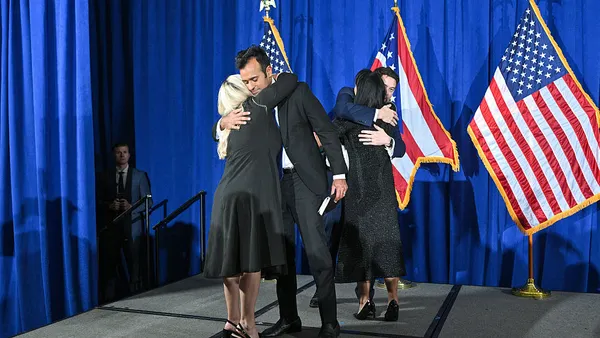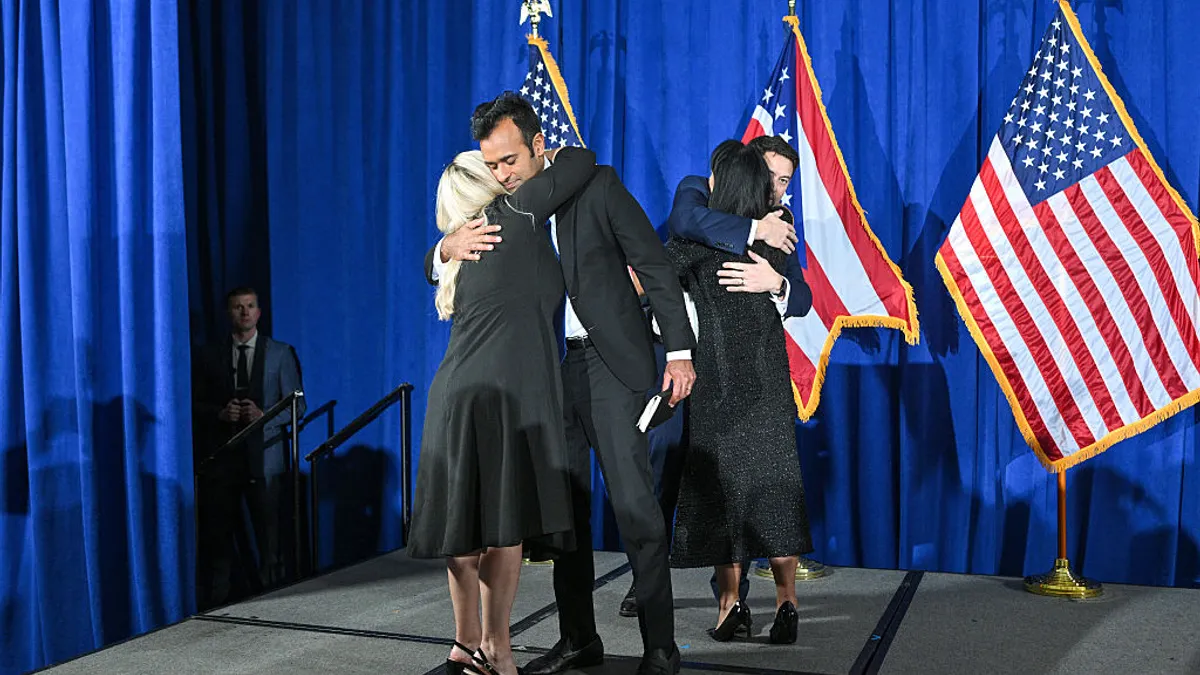
Vivek Ramaswamy lost Ohio’s governor’s race Tuesday amid a surge of Democratic support. It ended pretty ugly.
In the final days before the midterm elections, six biotech leaders publicly urged him to withdraw a television ad featuring the estranged mother of his opponent, Amy Acton, arguing that it ignored documented childhood trauma and betrayed the evidence-based standards of their industry. The ad had already drawn criticism from both parties. Ramaswamy, who was running as a Republican, defended it.
It was an unusually pointed rebuke from within the industry that had helped make Ramaswamy famous.
It also raises a question that tends to get skipped when he’s characterized as a ”successful biotech entrepreneur”: Successful at what?
The description isn’t invented. Roivant, the company he founded, built a network of specialized drug developers known as “Vants.” Axovant Sciences was its Alzheimer’s-focused subsidiary; other Vants went on to develop approved medicines and complete major deals. A 2023 PharmaVoice profile recalled how he had been hailed as a biotech wunderkind.
But there’s a difference between raising money and creating shareholder value with producing clinical evidence that holds up. Those distinctions matter when a business record becomes a political credential.
I helped tell an earlier version of that story. In September 2017, I brought Ramaswamy and four Roivant executives together for a Fortune interview and photo shoot. At the time, Roivant had just secured $1.1 billion in financing led by SoftBank, none of its Vants had an approved medicine and Axovant was awaiting pivotal Alzheimer’s trial results.
I called the turnkey business model audacious. I reported the risks. Still, the gravitational pull was obvious: The people had heavyweight pedigrees, the money was spectacular and the founder had a hell of a pitch.
What they didn’t yet have was proof that the lead drug worked.
The money was real, but the evidence was mixed
Not everyone waited for hindsight to ask harder questions. In June 2015, before Axovant’s IPO, reporter Adam Feuerstein examined the hedge-fund relationships and unusual financing terms behind the Alzheimer’s company.
His reporting examined the valuation investors were placing on an unproven drug and the financial terms offered to certain participants in the IPO.
The underlying bargain was stark. In December 2014, Roivant’s Axovant acquired intepirdine from GlaxoSmithKline for $5 million upfront, plus potential later payments.
By then, GSK had already completed two large phase 2 studies involving 576 and 684 patients, respectively. Conducted between 2008 and 2010, neither met its overall efficacy goals; the results were published in May 2015, after Axovant acquired the drug.
But some findings in patients also taking donepezil, an existing Alzheimer’s treatment, looked encouraging, justifying more research in that direction. The overall clinical evidence still did not establish that intepirdine worked.
Axovant nevertheless sold 24.15 million shares at $15 apiece in 2015, raising $362.3 million gross and $334.5 million net for the company. The SEC IPO prospectus also disclosed that Ramaswamy’s mother and brother, both employees, had been granted options covering 262,500 and 750,000 shares, respectively, at a 90-cent exercise price.
Two hedge funds, RA Capital and Visium Asset Management, bought a combined $150 million of Axovant shares at the $15 IPO price. They agreed not to sell for 90 days, while existing shareholders and executives generally faced 180-day restrictions. Other public IPO buyers could trade immediately.
What mattered was the timing: The funds became eligible to sell in September 2015, before Axovant began enrolling patients in its pivotal phase 3 trial that October.
Separately, the options granted to Ramaswamy’s mother and brother carried 90-cent exercise prices and four-year vesting schedules, creating potential gains tied to the share price.
The financing offered opportunities to benefit from Axovant’s valuation before the pivotal efficacy results arrived in 2017. The filings do not establish that anyone exercised options, sold shares or realized profits.
Ramaswamy’s public presentation was less qualified than the data. In an October 2015 CNBC interview, he said intepirdine was “statistically significantly better than the placebo.”
By the time Ramaswamy made those comments, Axovant had acquired the drug, completed its IPO and had access to the earlier GSK evidence. Its pivotal phase 3 trial testing intepirdine in combination with donepezil would begin enrolling patients later that month.
A preliminary analysis co-authored by his mother, an Axovant employee, had emphasized favorable results for the combination. But as PolitiFact recently documented, his comments did not clearly distinguish positive findings for intepirdine in combination with donepezil from the broader, disappointing trial record.
And then on Sept. 26, 2017, Axovant announced that its 1,315-patient phase 3 Mindset trial had missed both primary endpoints. No statistically significant improvement in cognition. None in daily functioning.
The stock collapsed. The clinic had delivered a much less marketable answer than the financing rounds.
During the Ohio gubernatorial race, Acton’s campaign claimed Ramaswamy made “hundreds of millions of dollars” pushing an Alzheimer’s drug “he knew didn’t work.” PolitiFact rated that assertion “Mostly False.” There was a gap between what the available studies established and what an investor or patient might have understood from the pitch.
The problem was not that he pursued a risky drug, and Axovant’s willingness to take on a late-stage study for intepirdine indicated some level of scientific conviction in its potential, PolitiFact pointed out. Axovant’s IPO proceeds were also corporate funds, not his personal take-home pay.
Ultimately, the trial failure did not establish advance knowledge or fraud.
Ramaswamy’s long shadow
He left Roivant’s day-to-day CEO role in 2021 and resigned from its board in 2023. By then, Roivant said six medicines developed at companies it launched had won FDA approval.
Under successor CEO Matt Gline, Roivant sold its 75% stake in Telavant, a joint venture with Pfizer, as part of Roche’s approximately $7.1 billion acquisition completed in December 2023.
PharmaVoice chronicled that deal and later interviewed Gline about pursuing overlooked opportunities in drug development. It is a record of real business achievement, not a company that disappeared with Axovant.
Roivant’s leadership also publicly distinguished its work from its founder’s political rhetoric.
During his brief bid to become the Republican presidential nominee in 2023, Ramaswamy invoked his biotech credentials to accuse the FDA of corruption and propose gutting the agency. STAT’s Feuerstein and Matthew Herper examined his claims and found serious factual problems. Gline publicly disagreed with the FDA attack.
“I think he’s wrong about the FDA,” Gline told The Wall Street Journal in a 2023 interview republished by Mint. “We have a lot of respect for them as our regulator.”
In a later PharmaVoice interview, Gline described the need to be “ruthlessly data-driven.” That’s a striking contrast in emphasis, though it does not erase what Ramaswamy contributed to building Roivant.
A Roivant spokesperson said the company had no comment on questions for this article. Ramaswamy’s campaign did not respond to a separate request for comment.
What’s the takeaway from Ramaswamy’s journey from biotech to politics?
Executive firepower, huge checks and founder mythology can set a certain tempo, but the actual clinical proposition isn't as forgiving.
Ramaswamy told Fortune a decade ago that Roivant’s “ultimate measure of success” would be whether it could validate its clinical bets and bring them to patients.
That same month, Axovant’s ostensibly star candidate missed both its primary clinical endpoints. And now Ramaswamy has lost two high-profile attempts to make it big in politics.
Wherever he goes next, “successful biotech entrepreneur” might remain a permanent line in his biography. These facts are a part of that story too.