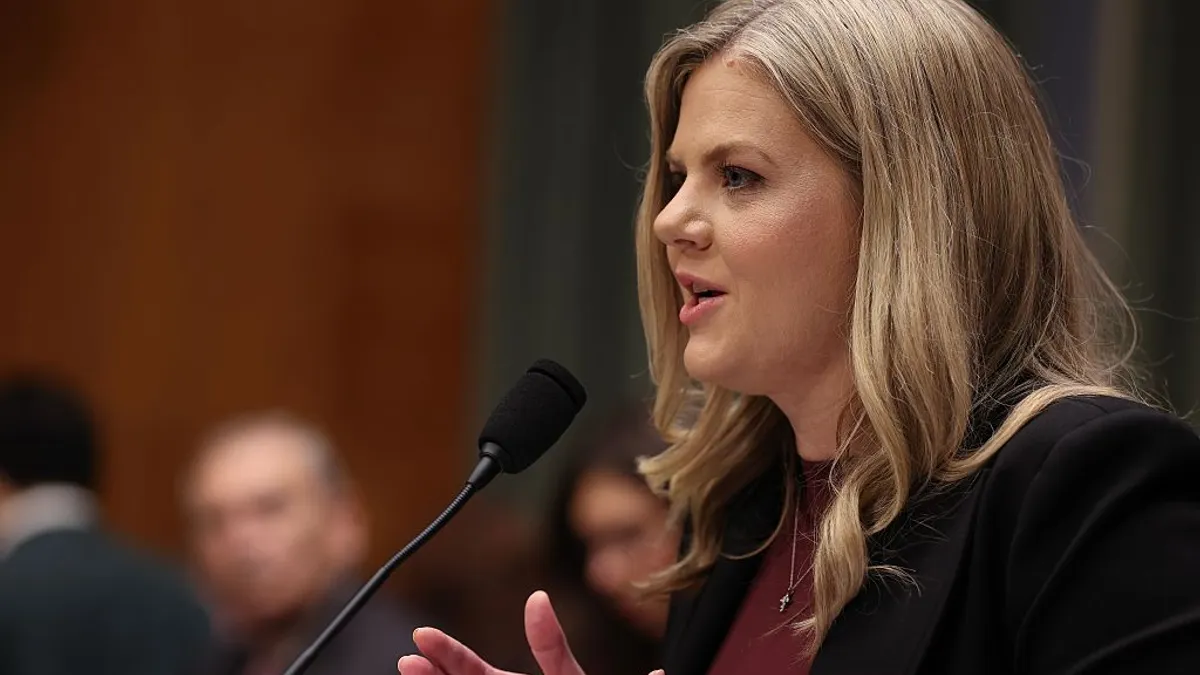

Heidi Overton, President Donald Trump’s pick to be the next commissioner of the FDA, told lawmakers Thursday that she would “follow the law” regarding decisions on vaccines and the abortion drug mifepristone if pressured by the White House to alter longstanding policies.
Speaking at a Congressional hearing to evaluate her nomination, Overton also vowed to push for reforms that can speed early research on new drugs and help the U.S. counter the fast ascent of China’s biotechnology industry.
Trump last month nominated Overton, a physician who is now a White House domestic policy adviser, to assume the FDA’s top position. She’d take over for Kyle Diamantas, who has been the temporary, “acting” leader since May, when Trump’s first commissioner Dr. Martin Makary resigned.
If confirmed, Overton would step into an agency seeking stability after a tumultuous 18 months. Under Makary, the FDA was rocked by layoffs and senior staff departures. The regulator was also accused of politically influenced decision-making and criticized for backtracking on agreements with drugmakers.
Vaccine policy, in particular, has been a lightning rod during and even after Makary’s tenure. He and top deputy Dr. Vinay Prasad established stricter frameworks for COVID shots, while a Centers for Disease Control and Prevention panel handpicked by vaccine skeptic and Health and Human Services Secretary Robert F. Kennedy Jr. issued multiple recommendations that went against established science.
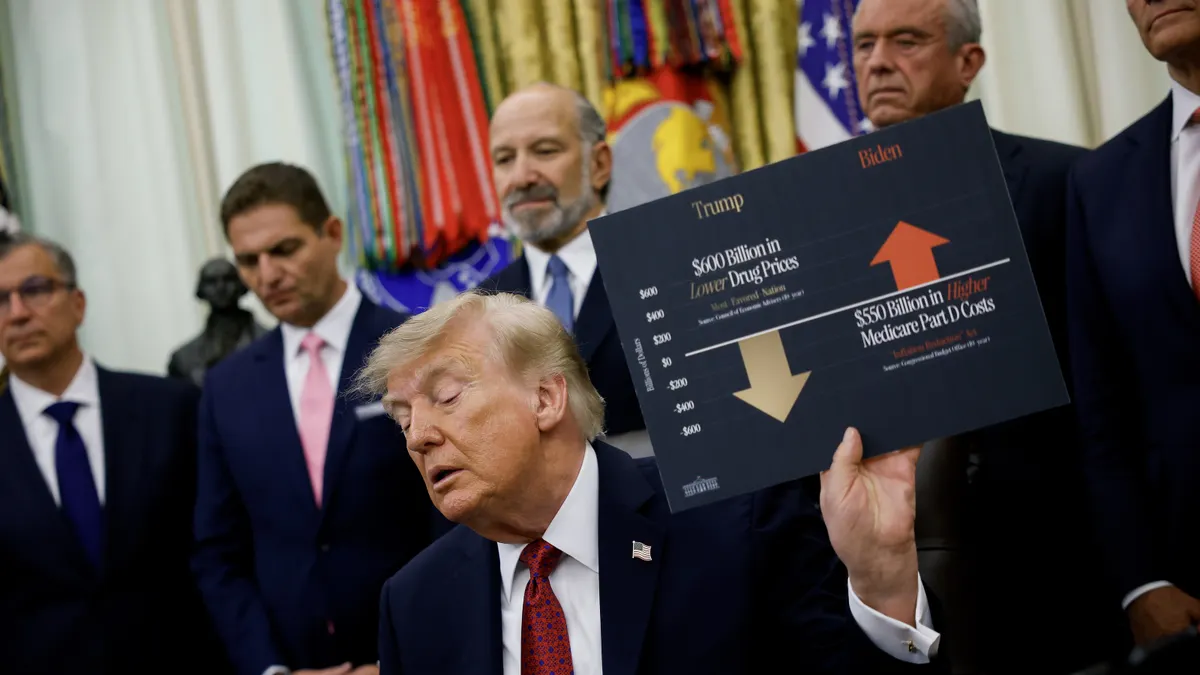
More recently, the White House in August issued an executive order aiming to pare down the U.S. childhood immunization schedule and split the measles, mumps and rubella vaccine into three separate shots. Trump, at the time, called the MMR vaccine “lethal.”
At Thursday’s hearing, lawmakers questioned Overton — who’d praised Trump’s executive order as “historic” — on that issue. The most pointed queries came from Bill Cassidy, R-La., who chairs the Senate Health, Education, Labor, and Pensions Committee reviewing Overton’s nomination and whose support is crucial. The HELP committee has 12 Republicans and 11 Democrats.
“You were standing behind President Trump when he called the MMR vaccine ‘potentially quite lethal.’ Is the MMR vaccine safe and effective?” Cassidy asked.
Overton responded affirmatively, referring to the MMR shot as “safe and effective” and the “best tool right now in the public health response to the measles outbreak.” She added that all marketed vaccines in the U.S. “are safe and effective according to the FDA” and that, if confirmed, she would follow the law in making “individual product determinations.”
Cassidy urged her to stand by that vow, citing previously broken promises from Kennedy.
“Secretary Kennedy gave me guarantees,” Cassidy said. “Later, he did not keep those. I asked him why not. He said that the president had told him to do something, and as opposed to keeping his promise to me, to this committee, and by extension the American people, he had to do what the president told him to do.”
Lisa Murkowski, R-Ak., joined Democrats in challenging Overton on federal policy regarding the abortion pill mifepristone, which the FDA has authorized for prescription via mail and telehealth visits. Testing and decades of use have shown it to be broadly safe and effective for terminating pregnancies. But pressure from anti-abortion groups and Republican members of Congress have led to a new safety study.
While serving in a health role at the America First Policy Institute, a conservative think tank, Overton authored an article characterizing mifepristone as “dangerous.” When pressed on her stance, Overton acknowledged that the FDA had determined mifepristone met agency standards for safety and effectiveness. She added, though, that she didn’t want to “prejudge” the ongoing review.
Separately, Overton signaled that she would follow through on FDA initiatives to help biotechs accelerate early drug research, among them the “Operation Trialblazer” initiative. Those plans have been made in response to an explosion of dealmaking for China-discovered medicines and the ripple effects those pacts might have on U.S. innovation.
“If I have the privilege of being confirmed, I will work with the dedicated career professionals to make sure every aspect of clinical trials and drug development is optimized,” Overton said. “This will not only bring development back to the United States; it will bring cures to patients faster.”
Following Makary’s turbulent tenure, the HHS has installed more traditional leaders in key positions at the FDA. Michael Davis and Karim Mikhail were appointed as acting directors of the agency’s two main drug offices and, in the ensuing months, the FDA reversed course on several controversial decisions. In early September, both were named permanent directors in decisions praised by analysts following the biotech sector.
Thursday’s hearing was a “net positive,” wrote RBC Capital Markets analyst Brian Abrahams. Overton “emphasized the need for U.S. leadership in innovation vis-à-vis China's rise,” as well as openness to regulatory flexibility and reliance on career staff, he wrote. She’s also “likely to continue certain innovative or valued FDA practices, such as advisory committees.”
Whether she’s eventually sworn in is “unclear” and may depend on whether the vote comes before or after the midterm elections in November, Abrahams wrote.
Overton’s role in Trump’s orbit and the federal government has been largely quiet and behind the scenes, serving as a White House fellow in the final years of his first term and then moving to the America First Policy Institute after Trump left office in 2021. She later rejoined the administration as a policy aide.