
Nuclear medicine has always had a quiet superpower: it helps clinicians make decisions based on biology, not guesswork. A radiopharmaceutical tracer can reveal how a tumor behaves, where it has spread, and whether a patient is likely to benefit from a specific next step.
What is different today is that nuclear medicine is no longer defined only by what it can show. Increasingly, it is defined by what it can do.
Radioligand therapy (RLT) takes the same precision logic that made molecular imaging indispensable and applies it to treatment: a targeting molecule seeks out a marker on cancer cells, carrying a radioactive isotope that delivers radiation directly where it is needed. It is drawing attention across oncology as a powerful addition for patients who need more targeted options.
Theranostics builds on that foundation. It links diagnosis and therapy through the same molecular target – see it, then treat it – so patient selection and treatment strategy are connected by design rather than stitched together after the fact.
As this field becomes more mainstream, the conversation tends to focus on targets, pipelines, and clinical data. Those are essential. But the next phase will be shaped by something leaders often underestimate.
In nuclear medicine, operations are part of the treatment. And they will decide which companies can scale theranostics beyond flagship centers.
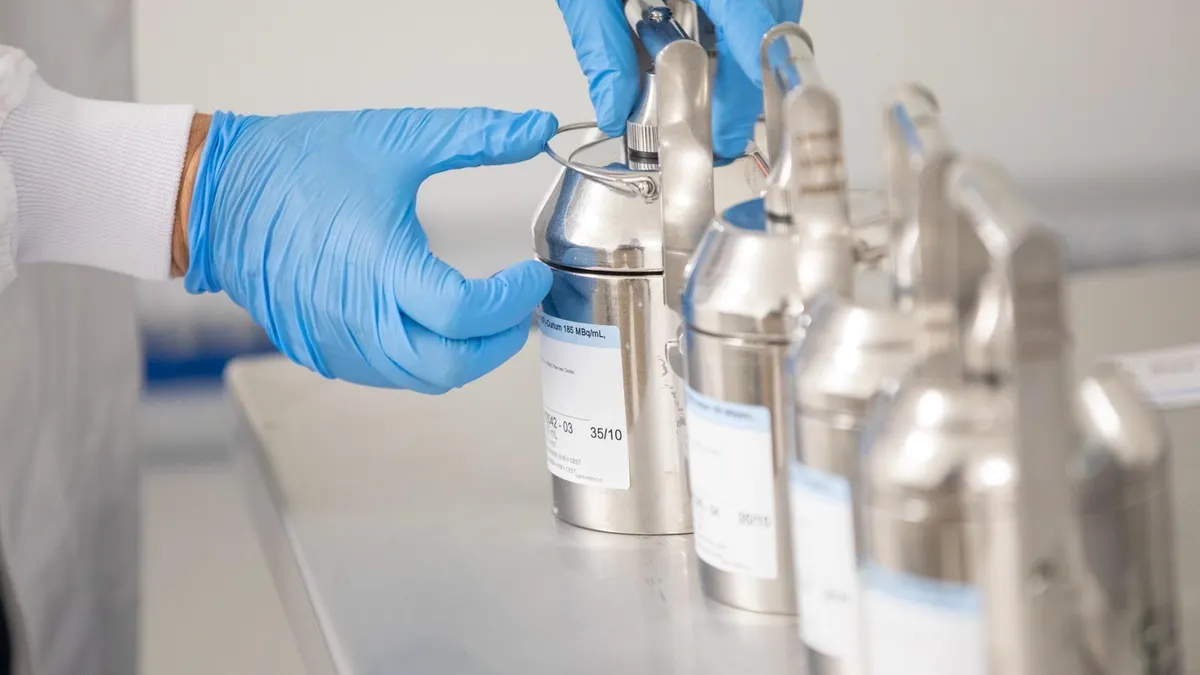
Many radiopharmaceuticals decay continuously. That constraint changes the rules - it means manufacturing, quality release, and distribution are not separate steps that happen to be adjacent; they function as one time-bound system. When that system performs, clinicians can schedule with confidence and patients can stay on track. When it does not, the consequences are immediate: missed scans, delayed treatments, disrupted care pathways.
At Curium, our focus is 100% nuclear medicine – developing, manufacturing, and distributing radiopharmaceuticals used in SPECT and PET imaging and in therapy, with the goal of supporting timely diagnosis and treatment across diseases including cancer. And we describe our work as similar to “shipping ice cubes.” It is a vivid metaphor because it is accurate: time is part of the product. And it is precisely why reliability in this modality should be treated as a form of patient care, not just an operational afterthought.
The industry’s default mental model is a risk
Most modalities can bolt operations on after approval. Radiopharmaceuticals cannot.
If you treat delivery as downstream “supply chain work,” you will find yourself solving the hardest problems when the stakes are highest: as demand rises, as sites expand, and as variability shows up in the real world.
In a time-bound modality, every additional handoff adds friction. Every ambiguous decision adds delay. And every avoidable disruption erodes confidence – not only among providers, but among the very teams inside biopharma who are deciding where to place capital, which partnerships to pursue, and which platforms are truly scalable.
What industry leaders underestimate about scaling theranostics
Three points deserve more consideration:
- The bottleneck is orchestration, not interest. Scaling requires manufacturing release, logistics, and site scheduling to behave like one system – consistently.
- Fragmentation creates patient risk. The more disconnected the value chain, the more vulnerable the patient timeline becomes, especially when conditions change.
- Site readiness becomes the limiter at volume. Scaling is not only about adding sites; it is about making performance predictable across sites.
This is why Curium’s operating philosophy emphasizes continuity by design and end-to-end accountability – fewer handoffs, clearer ownership, and faster correction when real life intervenes.
If a cyclotron producing medical isotopes goes down, its entire production line must be diverted to the nearest plant. That shift requires rapid adjustments to logistics to ensure patients still receive the diagnostic or treatment at the specific time prescribed by their specialist. This could mean diverting the production from Western Europe to Eastern Europe, or even the United States, and all the travel challenges that entails.
A more complete definition of innovation
None of this is an argument against innovation. It is an argument for a more complete definition of it.
If theranostics is to become a dependable pillar of oncology, we have to design the science and the delivery system together so that precision does not end at the molecule, and promise does not stop at approval. That requires decisions and investments that look less like “logistics optimization” and more like platform strategy: continuity engineered into networks, accountability designed into operating models, and disciplined scale built to perform under pressure.
That is where nuclear medicine’s next chapter will be written: not only in what we discover, but in what we make reliably reachable for patients.