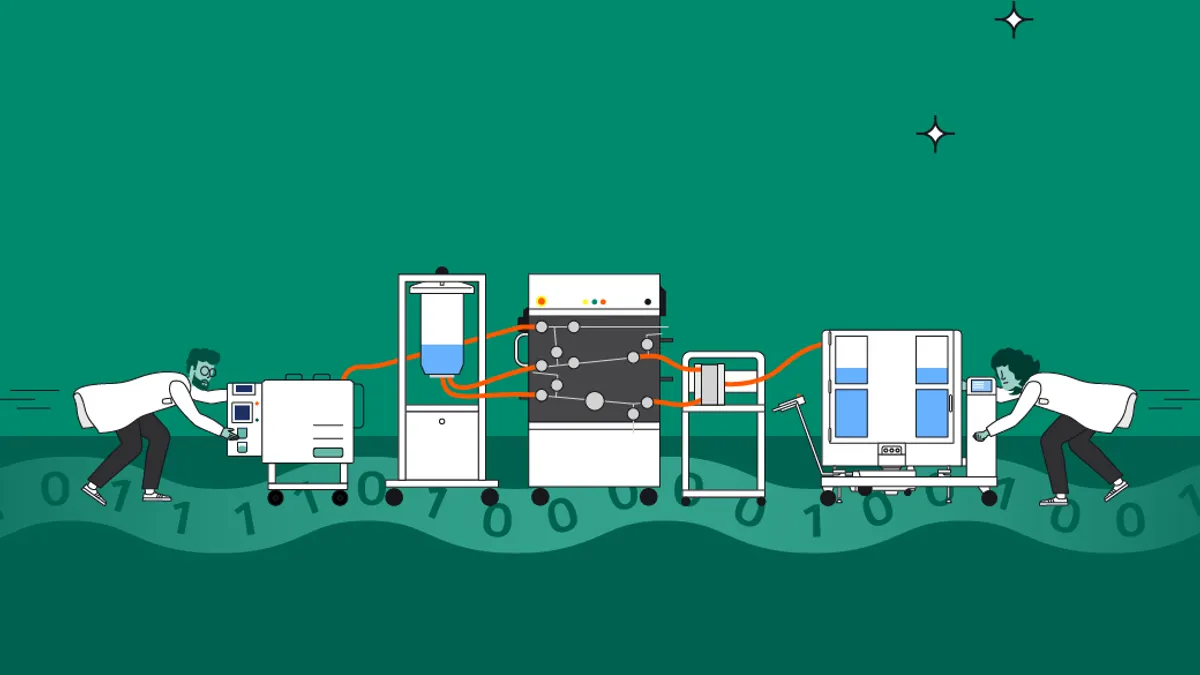

Modern biopharma manufacturing faces many challenges, including process execution, observability, digital transformation and reliability. While each topic addresses a different aspect of manufacturing performance, they all contribute towards a common objective: creating greater confidence in how decisions are made.
Over the last decade, biopharma manufacturers have invested heavily in automation, connectivity, data platforms and digital technologies while navigating the challenges of integrating legacy infrastructure and modern manufacturing systems to produce increasingly diverse therapeutic modalities. As a result, organizations today have access to more process, equipment and operational data than ever before. The challenge has moved from collecting information to using that information to anticipate outcomes before they occur.
Historically, manufacturers have focused on understanding what happened. Increasingly, the goal is to understand what is likely to happen next. In many ways, this represents the next stage in the digital evolution of the industry, where confidence in predictive systems becomes just as important as the technology itself.
Moving beyond hindsight toward model-driven bioprocess control
For decades, manufacturing improvement has relied on hindsight: deviations occur, root causes are identified and corrective actions follow. While effective, this approach is labor-intensive, difficult to scale and increasingly challenged by demands for greater productivity, flexibility and efficiency.
Model-driven manufacturing offers a more proactive approach, using process knowledge, historical and real-time data and equipment performance to predict process behavior and anticipate risk. This can range from mechanistic models and digital twins that simulate potential scenarios to advanced process control (APC) systems that use predictive models to automatically adjust operating conditions.
Models are only as good as the foundations beneath them: enabling advanced process control in bioprocessing
The potential of model-driven manufacturing depends on more than data. Effective models also require deep process understanding, subject matter expertise and the ability to distinguish meaningful signals from operational noise.
They must also evolve with the manufacturing environment. Changes to equipment, processes, operating conditions, or modalities may require models to be refined and recalibrated. Building the expertise, infrastructure and governance to manage this lifecycle is therefore becoming an important organizational capability, particularly as manufacturers move toward greater use of APC and model-driven decision-making.
The foundations have already been built: empowering mechanistic models and digital twins for biopharma manufacturing
Model-driven manufacturing may sound futuristic, but many of its foundations are already in place. Investments in automation, observability, digital connectivity and reliability have improved data availability, process understanding and operational consistency.
Together, these capabilities enable manufacturers to develop in silico models and digital twins to predict the impact of process changes before implementing them. Over time, this creates a pathway toward model predictive control, where routine adjustments can increasingly occur within defined operating parameters while people retain oversight.
The value is not the model itself, but the combination of process understanding and predictive insight to enable tighter control, reduced variability, improved yield and more consistent manufacturing outcomes.
Building trust in predictive operations for closed-loop bioprocessing
Perhaps the biggest challenge in model-driven manufacturing is not technology, but trust. Closed-loop and continuous manufacturing require confidence in the data and models used to make or automate decisions, as well as the ability to demonstrate that those systems are reliable and validated.
Other industries offer a useful precedent. Modern aircraft rely heavily on automation, while pilots retain oversight and intervene when circumstances demand it. Biopharma is likely to follow a similar path, with predictive systems increasingly identifying risks and recommending actions while human expertise shifts toward oversight, optimization and managing exceptions.
The future role of human expertise in model-driven bioprocess control
One of the most common misconceptions surrounding AI, predictive analytics and model-driven manufacturing is that they are intended to replace people. In fact, the reality is that roles will change, not be made redundant. Scientists, engineers and manufacturing specialists possess knowledge, experience and contextual understanding that no model can fully replicate. The objective is not to eliminate human involvement, but to reduce the need for routine intervention and increase the value of the expertise people provide.
As these technologies mature, demand is likely to increase for skills in data science, modelling, process analytics, systems integration and digital manufacturing. The future workforce may spend less time collecting information and more time interpreting, optimizing and improving how we use it.
This creates opportunities for people to focus their expertise where it delivers the greatest value, including process optimization, continuous improvement, innovation, technology transfer, manufacturing strategy and accelerating the delivery of therapies to patients. In many ways, the ultimate goal of model-driven manufacturing is not automation itself, but enabling human expertise to be applied more effectively.
An emerging and untapped competitive advantage
As access to data, automation and digital technologies continues to expand, most organizations will eventually collect similar information from similar systems. Manufacturers that can anticipate outcomes, evaluate alternatives and act before problems occur will gain advantages in productivity, quality, reliability and operational performance. As processes become more predictable, organizations can spend less time managing uncertainty and more time driving improvement.
In many ways, this may become the next manufacturing battleground. The organizations that outperform will not necessarily be those with the most sophisticated technology. They will be those that can translate predictive insights into trusted decisions and consistent execution.
From uncertainty to confidence in model-driven biomanufacturing
The future of biomanufacturing is not simply connected, automated, or digital. Key elements work together to build a foundation for the future. Closing the execution gap will enable action. Increasing bioprocessing observability will create understanding. Digital transformation will lead to connectivity. Reliability will increase confidence. Model-driven manufacturing will enable anticipation, or, proactive versus reactive processes. Together, they represent the industry's journey from reacting to events towards shaping outcomes.
We may never completely trust the models behind predictive manufacturing. However, processes may become predictable enough that human expertise will eventually focus less on managing uncertainty and more on creating improvement, innovation and value.