
The biopharma industry doesn’t have a technology problem, it has an implementation problem
Over the last few years, digital transformation has become one of the most widely discussed topics in biopharma manufacturing. Automation, advanced analytics, digital twins, the use of artificial intelligence (AI) and connected manufacturing processes have all featured prominently in transformation roadmaps designed to improve operational performance and accelerate the delivery of therapeutics to patients.
On the surface, industry is aligned. Yet despite this ambition, progress is falling short of expectations—some might say, biopharma is experiencing a digital transformation failure. Ashley Howard, Senior Product Director for Automation and Digital at Cytiva, observes:
“The value of digital transformation is understood. The challenge is bridging the gap between where we are today and what it takes to realize that value. That requires more than technology. It requires changes to organization structures, incentives, day-to-day ways of working and decision-making across all those functions involved in manufacturing. For many organizations, the gap is so wide that knowing where to start can feel overwhelming.”
Biopharma doesn’t have a digital strategy problem. It has an implementation problem. The industry understands where it must go. What it continues to struggle with is how to best get there.
Digital ambition is no longer the barrier
Few organizations today would argue against the need for digital transformation. Better data can improve process understanding, automation can reduce variability and increase consistency and connected manufacturing systems can accelerate decision-making. At the same time, new therapeutic modalities, accelerated development timelines, growing expectations around productivity, increasing labor costs and pressure on facility utilization are changing the economics of biopharma manufacturing.
Digital transformation is becoming an operational necessity as biopharma faces greater complexity, faster timelines, rising costs and pressure on productivity. Better data, automation and connected systems can improve performance, but recognizing their value is different from delivering it. Digital execution remains the bottleneck.
Why digital transformation fails in bioprocessing: it’s not lack of commitment, it’s implementation
Digital transformation in biopharma is slowed not by resistance to change, but by the realities of regulated manufacturing. Legacy infrastructure, organizational silos, validation and compliance requirements, limited resources, cybersecurity concerns and skills gaps can make implementation difficult.
In a risk-averse industry, disruption can quickly outweigh the perceived reward. As Ashley observed, “The cost and risk of change often outweigh the perceived benefit.”
The challenge is not knowing what needs to change, but demonstrating that the value justifies the effort, risk and organizational commitment required to deliver it.
Digital fragmentation in biomanufacturing: the problem with starting at the destination
One of the most common causes of failure is the belief that transformation needs to be comprehensive from the outset. Transformation can stall when organizations try to solve everything at once. Successful transformation starts by solving a specific problem, proving value and building momentum. Progress comes from implementation, not perfection
AI is exposing weak foundations for digital transformation
Across the industry, organizations are exploring how artificial intelligence (AI) might accelerate process development, improve manufacturing performance, strengthen decision-making and unlock competitive advantage. However, the growing interest in AI has also exposed existing challenges that were often tolerated or overlooked. Advanced analytics, machine learning and AI are dependent upon accessible, trusted and contextualized data.
As Ashley put it: “You can't just throw AI at it, you have to build the foundations first.”
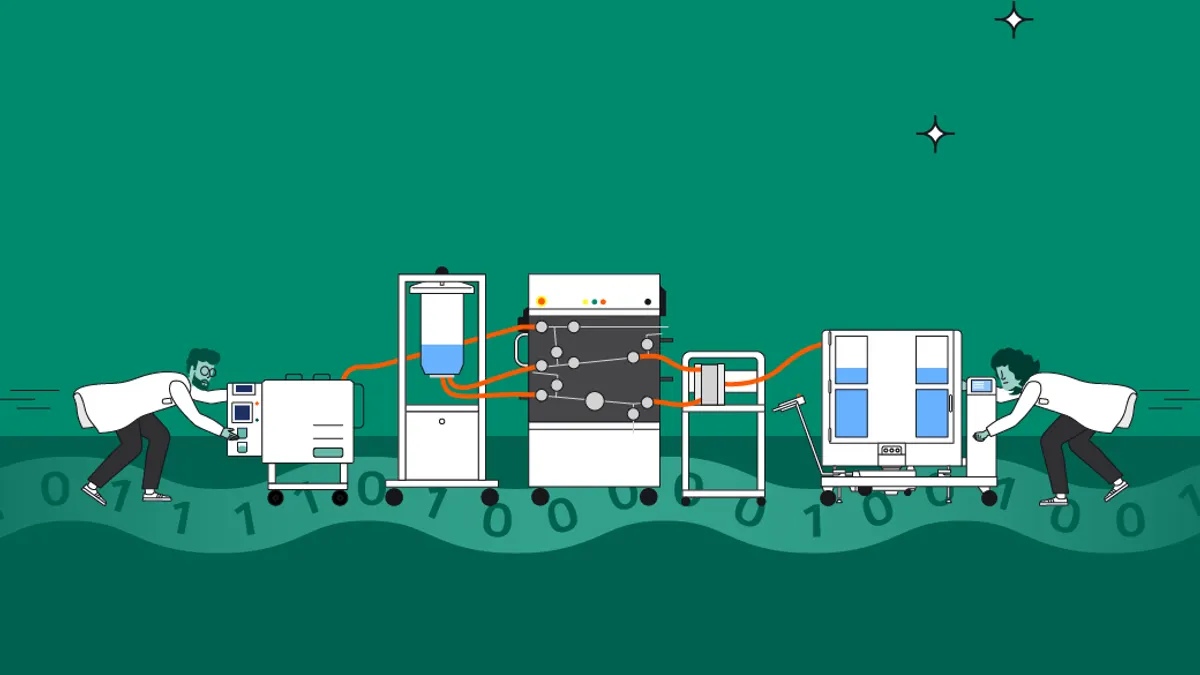
For many organizations, the starting point is not AI itself, it’s integrating disparate systems and data for AI to use more effectively. Most bioprocesses produce too much data relative to too little insight. That’s because data is collected across multiple systems and process stages but isn’t accessible, contextualized or connected in a way that supports real-time data-driven insights and decision-making. Establishing trusted data foundations, improving contextualization and ensuring data can move effectively across systems will go a long way toward overcoming silos in pharma digital transformation.
When successful pilot projects stop moving forward
One of the most common frustrations in biopharma is that a proof-of-concept may demonstrate clear value within a specific process, department or site; but extending that success across an organization is significantly more difficult. Successful pilots often struggle to scale across biopharma. Pilots prove the technology, but scaling requires proving the operating model, including integration with infrastructure, governance and ways of working. Organizations that scale successfully treat pilots as a first step, building repeatable processes, stakeholder alignment and a model that can be replicated across sites and functions.
Regulators acknowledge and address validation and compliance barriers
Biomanufacturers often rely on legacy systems with siloed databases. Changes can require extensive documentation and testing, making it easy to understand why an organization might hesitate to adopt new digital technologies.
Regulators are acknowledging these challenges and encouraging a more flexible, risk-based approach. For example, the US Food and Drug Administration (FDA) recently finalized Computer Software Assurance (CSA) guidance that recommends focusing validation activities on higher-risk software functions and reducing documentation for lower-risk changes (1). This shift shows a growing regulatory openness to removing unnecessary barriers to innovation—provided product quality remains robust.
Minding the skills gap in digital bioprocessing
According to the Cytiva Biopharma Resilience Index, more than one-third of executives surveyed reported challenges in finding skilled staff to support digital and AI efforts (29%) (2). By investing in people—through upskilling or recruiting digital talent—as much as digital technology, organizations can start to bridge this gap.
From ambition to execution: overcoming digital transformation failures
The biopharma industry does not lack digital ambition or technology. What it continues to struggle with is implementation—or taking that first step. Until the industry becomes more confident on how to close that gap, digital transformation will continue to remain aspiration for a little longer as organizations rise to meet the challenges.
References
- US Food and Drug Administration. Computer software assurance for production and quality management system software. Published February 3, 2026. https://www.fda.gov/media/188844/download. Accessed August 3, 2026.
- Cytiva. Global Biopharma Index 2025: The innovation illusion: why biopharma breakthroughs aren't moving the market. Published 2025. https://cdn.cytivalifesciences.com/api/public/content/HfzkmyqaSNSfYvvAVjLudQ-pdf. Accessed August 3, 2026.