The personalized cancer vaccine field leaped forward last month when Merck and Moderna’s personalized melanoma vaccine scored big in a phase 3 clinical trial. Moderna’s stock soared, and the trial’s principal investigator hailed the results as a “landmark” moment.
The companies reported only topline results and plan to present detailed data at an upcoming medical meeting. However, delivering personalized cancer vaccines to the masses will require more than strong clinical results. It’ll also require pharma manufacturing to adapt.
“The challenge is in the fact that this is n-of-1 production, and it's kind of flipping conventional manufacturing entirely on its head,” said Amy Walker, CEO of 4basebio, a synthetic DNA maker that supplies the mRNA and vaccine markets, and co-chair of the Alliance for mRNA Medicines’ European Committee. “That, I think, is the challenge that we collectively as a field will face. How do you scale out versus scale up?”
Unlike traditional vaccines that prevent disease, personalized neoantigen cancer vaccines are custom-made treatments that teach the immune system to recognize and attack tumor cells bearing patient-specific mutations. That means every vaccine is tailored to the patient.
For that reason, manufacturing them is complex and lengthy. First, researchers biopsy the tumor and genetically sequence both the tumor and healthy blood cells to compare them and identify mutations that produce neoantigens. Then, they choose which neoantigens to target and create synthetic mRNA encoding them. (Merck and Moderna’s cancer vaccine encodes up to 34 neoantigens.) Finally, the synthetic mRNA is injected into the patient, where it instructs cells to produce the selected neoantigens and generate specific T-cell responses against cancer cells.
At commercial scale, the process would require high-tech computational tools and an enormous “scale-out” architecture to make tens of thousands of individual batches rather than one large batch. The process would also require rigorous chain-of-identity tracking to ensure patients receive the correct treatment, as well as specialized purification for each batch.
The personalized production problem
Despite the promising science, the industry needs to streamline manufacturing before it can successfully commercialize personalized cancer vaccines, Walker said.
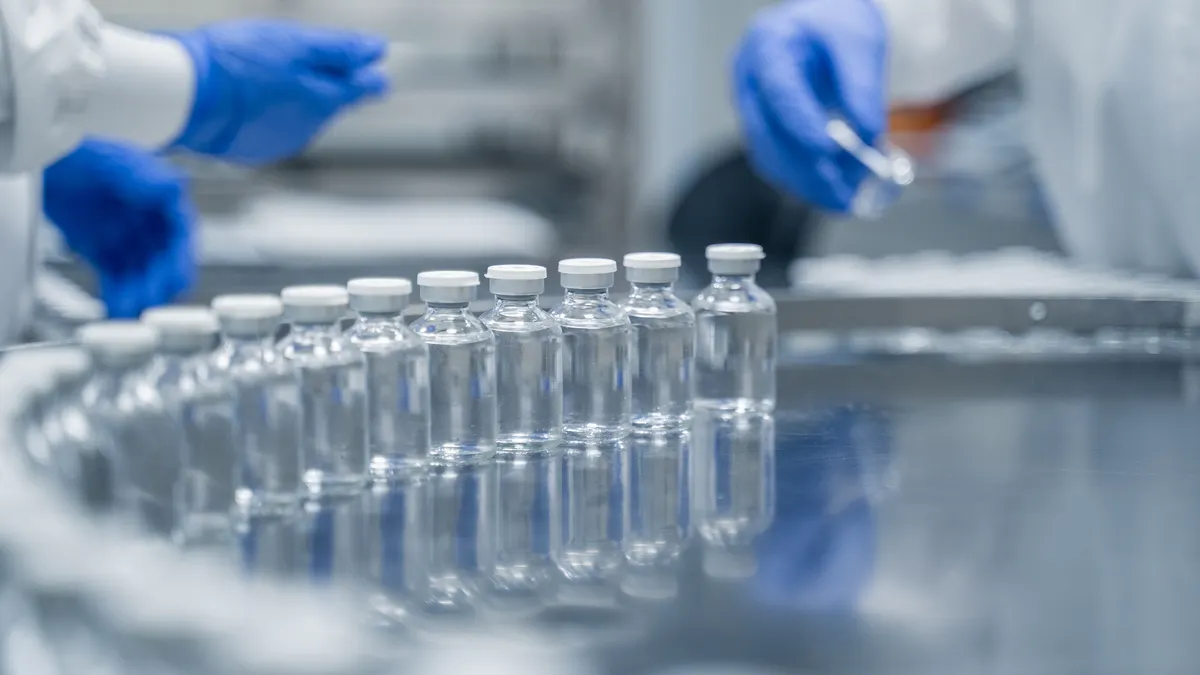
Moderna says it has already operationalized an automated manufacturing process that produces patient-specific intismeran batches in parallel, with a typical manufacturing turnaround time of a few weeks. Its purpose-built Marlborough, Massachusetts, facility began supplying clinical batches in September 2025 and is being prepared for a potential commercial launch.
“It will be a wake-up call to the manufacturing partners that the CDMOs [contract development and manufacturing organizations] work with… to really think about how they change their operations such that they can facilitate such bespoke manufacturing,” Walker said. “I hope that there will be a collective effort from the industry to facilitate that.”
Plus, it all needs to happen quickly. Walker said the “collective ambition” within the industry is a six- to eight-week turnaround from biopsy to dosing since the patients are “super sick.”
Cost is important, too.
“The price point really matters on these therapies. That's something that we absolutely want to get right from the get-go such that the cost is not prohibitive to access,” Walker said.
Although Provenge, an autologous cellular immunotherapy for prostate cancer, uses a different personalized-treatment model, it offers a cautionary precedent. Dendreon had blockbuster ambitions for the drug when it won FDA approval in 2010, but manufacturing and cost challenges contributed to its commercial struggles. Provenge’s manufacturing costs initially approached 77% of its selling price, and the treatment launched with a $93,000 list price. Dendreon filed for bankruptcy less than five years later.
Although Provenge remains on the market and is the only FDA-approved personalized cancer vaccine, the drug never lived up to its commercial expectations, and Dendreon subsequently changed hands several times.
Hot tumors, cold reality
Nine days after Merck and Moderna reported their phase 3 success, BioNTech and Genentech terminated a phase 2 study of their personalized colorectal cancer vaccine. An independent monitoring board found a numerical imbalance in overall survival between the treatment arms and concluded that continuing the trial was unlikely to change the efficacy outcome, but identified no new safety signal associated with the vaccine, BioNTech said.
The termination illustrates another challenge facing personalized cancer vaccines.
First, unlike Merck and Moderna’s trial, which combined intismeran autogene with the immunotherapy Keytruda, the terminated BioNTech and Genentech trial tested their candidate, autogene cevumeran, as a monotherapy. Monotherapies have historically been more challenging in the personalized cancer vaccine space.
Despite the monotherapy setback, BioNTech and Genentech are still studying autogene cevumeran in combination with checkpoint inhibition and chemotherapy in pancreatic cancer, the companies said.
Second, Merck and Moderna tested intismeran autogene in patients with resected melanoma, which is considered an immunologically “hot” tumor type. BioNTech and Genentech tested autogene cevumeran in colorectal cancer, which is generally considered immunologically “cold” and harder to treat with immunotherapy.
“A hot tumor has a lot of tumor mutational burden and so [that] makes itself ideally suited to the likes of a personalized cancer vaccine,” Walker said. Cold tumors, on the other hand, “don't express as many neoantigens that are unique and discrete to the tumor and so that makes it much more challenging to target.”
Although the development and commercialization challenges are significant, Walker doesn’t believe they’re insurmountable.
“I think that we collectively will overcome these hurdles. We will be able to identify new antigens that are more immunogenic, which lead to the therapy being more successful,” she said.
She also hopes that generating a “wealth of data” from so many unique tumor biopsies will eventually help identify shared targets for off-the-shelf cancer vaccines.
“If we flag, for example, that there is a mutation that is consistently prevalent across all of these tumors, then why would we not ultimately be looking for an off-the-shelf vaccine or immunotherapy in due course?” she said. “I think that's really exciting.