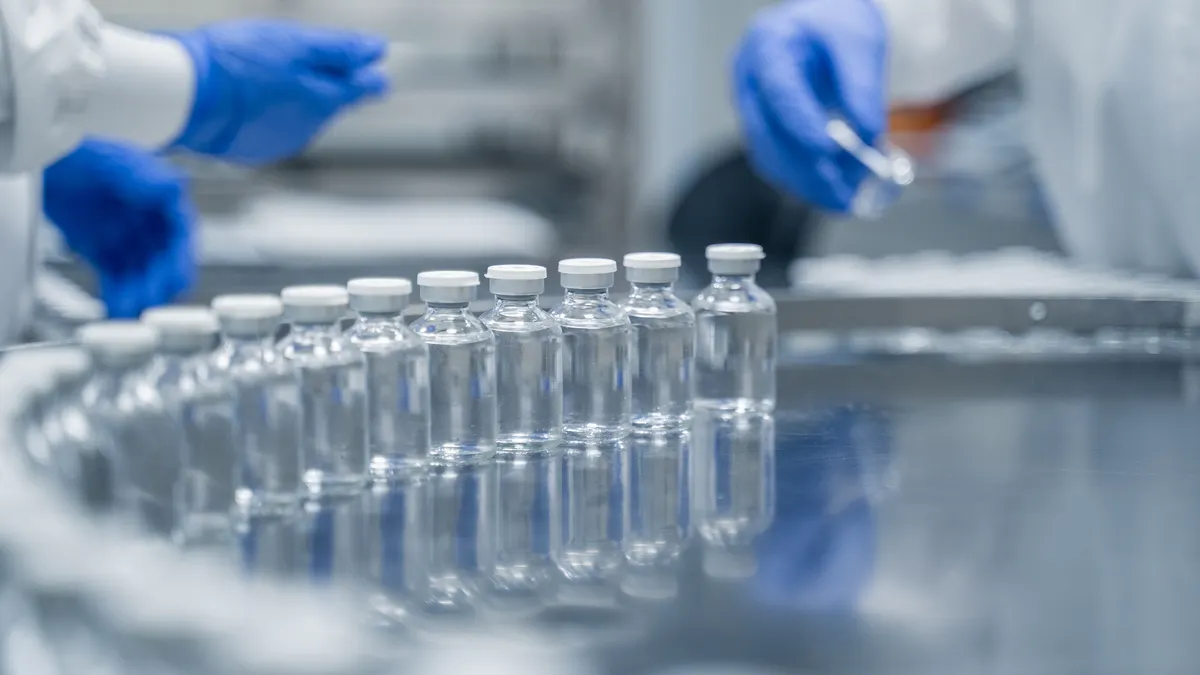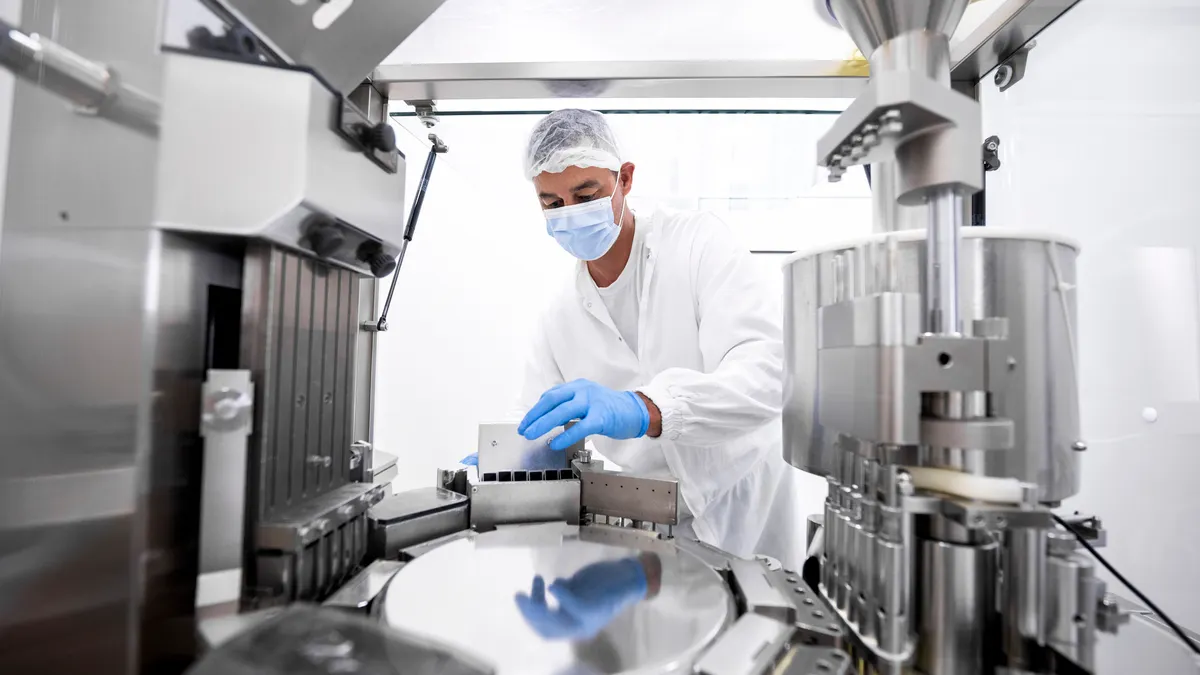
At the Raritan, New Jersey, facility where Legend Biotech and Johnson & Johnson manufacture Carvykti, a multiple myeloma patient named Colleen met some of the employees who had worked on the CAR-T cell therapy batch she received while battling for her life.
It was a meeting that showcased the deep personal connection patients have to CAR-T therapies, Legend said. And for the autologous CAR-T manufacturer, it also laid bare the therapy’s unique operating model: A commercial dose is not just tied to a product. It is tied to one patient.
Carvykti’s commercial footprint is expanding quickly. First approved in 2022, the autologous CAR-T therapy notched $657 million in second-quarter net trade sales, 50% above the year-earlier period, with the therapy available at 348 sites across 19 markets.
But years into commercial CAR-T, the fundamental constraint has not changed: Growth still means adding thousands of individualized manufacturing runs rather than simply producing larger batches.
As demand grows, the manufacturing challenge is not simply making a bigger batch. Patient cells, manufacturing slots, quality testing, release dates, logistics and treatment center schedules all have to move together.
“When you scale an autologous cell therapy, you don’t scale up, you scale out,” Mike O’Mara, chief operating officer of cell therapy contract development and manufacturing organization Cellipont Bioservices, said via email.
At small clinical volumes, a single, tight-knit manufacturing team can serve a limited number of patients. A larger commercial scale changes the calculus. Manufacturers are not simply making more of the same batch; they have to reproduce a patient-specific process across more batches with more teams at the same time.
That makes manual steps and operator-to-operator variability more consequential. A few highly experienced employees may be able to manage a process consistently during early development. At commercial scale, several teams have to reproduce it without introducing new variability. Automation and closed processing can help, O’Mara said.
The broader industry has been moving in that direction. A June review of CAR-T manufacturing in the PDA Journal of Pharmaceutical Science and Technology described a shift from highly manual academic processes toward more standardized commercial platforms, with stronger process controls enabling more predictable scale-out.
A cleanroom is only one piece of the capacity puzzle. O’Mara said commercial production also depends on trained employees, equipment, quality systems, analytical testing, raw materials, data management and logistics.
“The real question is not simply, ‘Can we manufacture another batch?’” he said. “It is, ‘Can we manufacture it, test it, release it and deliver it consistently within the required timeframe?’”
Legend has spent years building that wider system around Carvykti. The company’s model uses U.S. manufacturing for U.S. patients and European manufacturing for European and some other international markets, Alan Bash, Legend’s interim CEO and former president of its Carvykti business, told PharmaVoice.
All four Carvykti manufacturing sites are now online: its expanded Raritan facility; a Novartis contract manufacturing site in Morris Plains, New Jersey; and the Obelisc and Tech Lane facilities in Ghent, Belgium.
“When you scale an autologous cell therapy, you don’t scale up, you scale out.”

Mike O’Mara
Chief operating officer, Cellipont Bioservices
The scale is measurable. Legend said its expanded Raritan site has installed capacity to support treatment of up to 10,000 patients annually. In the first quarter, the company reported a 99% manufacturing success rate and a 29-day median turnaround time in the U.S., along with more than 95% on-time order releases for final product delivery dates.
Those are company-reported metrics, but they show how manufacturing performance becomes part of the commercial proposition for a personalized therapy: Growth depends on adding volume without losing reliability.
The bottleneck can be anywhere
A finished CAR-T dose also has to clear testing and quality review, while production depends on specialized materials that can carry their own supply constraints. At commercial scale, a bottleneck in any of those steps can slow the entire process.
“At larger scale, each one of those steps must be able to keep pace with manufacturing,” O’Mara said.
The patient’s treatment center is part of that system, too. Sponsors have to align clinical recruitment and scheduling with manufacturing slots reserved by a CDMO, O’Mara said. A canceled or delayed procedure can leave reserved manufacturing resources stranded.
That creates a two-way dependency: Treatment center schedules can affect manufacturing utilization, while manufacturing and release timelines can determine when a patient can be treated.
Some downstream friction has eased. In June 2025, the FDA eliminated REMS requirements for approved BCMA- and CD19-directed autologous CAR-T therapies, including Carvykti. The agency also updated labels to streamline post-treatment monitoring and shorten the periods patients are advised to remain near a healthcare facility and avoid driving to two weeks. FDA said the changes were expected to improve access, particularly for patients in rural areas.
Legend and J&J have also been expanding Carvykti use in outpatient and community settings.
Those changes can ease what happens after a product is released. What they can't do is remove the upstream need to coordinate the manufacturing run that actually lands on a patient.
Build for commercial scale before you need it
For developers, the most important scaling decisions may therefore happen well before commercial launch.
“The most common misconception is that there will always be time later to optimize the manufacturing process,” O’Mara said.
A highly manual step, difficult-to-source raw material or slow assay may be tolerable in a small clinical trial. Later, the same choice can become an operational constraint. Changing a process deeper into development can also require comparability work, additional validation and more regulatory interaction.
Developers do not need a fully commercialized process in phase 1, O’Mara noted. But they should understand which steps are likely to become limiting as volume grows.
That puts manufacturability alongside efficacy and safety as a development consideration, not merely an operations problem waiting at the end.
What happens if you remove the batch?
The next generation of CAR-T could tackle the problem by removing parts of the ex vivo manufacturing chain altogether.
Legend is among several companies testing in vivo CAR-T options that use a gene vector to modify immune cells inside the patient. The company’s early-stage candidate LB2501 is designed to generate CD19/CD20-targeting CAR-T cells inside the patient after a single infusion of a lentiviral vector. The company reported early proof-of-concept data from 12 patients with relapsed or refractory B-cell non-Hodgkin lymphoma in an ongoing phase 1 study in June. The treatment generated dose-dependent CAR-T expansion without lymphodepletion, and Legend reported no dose-limiting toxicities, serious adverse events or deaths at the data cutoff.
The 12-patient readout is only an early test of that model. Bash said longer follow-up still has to establish its safety, while efficacy will need to be strong enough to compete with existing treatment options.
The scaling model changes with it. Autologous CAR-T requires another external cell-processing run every time another patient is treated. An in vivo therapy could instead shift much of that manufacturing burden to a standardized vector product produced across patients.
It would not eliminate manufacturing — the vector still has to be produced reliably at commercial volumes — but it could simplify the process.
As cell-therapy manufacturing models diversify, O’Mara said, CDMOs will need systems flexible enough to support different approaches and a broader role helping developers design processes that can ultimately scale commercially.
For autologous CAR-T, every additional patient still adds another manufacturing run to the system. How well companies can industrialize that individualized process — or replace parts of it entirely — will shape how far the therapy can reach.