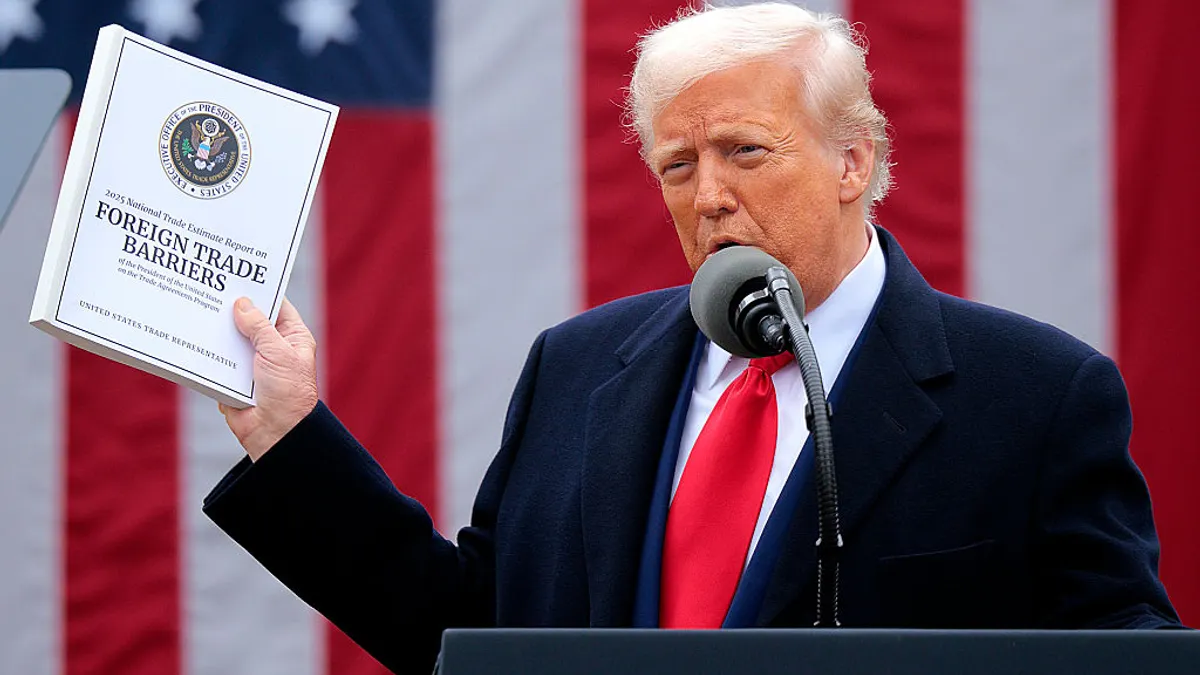
President Donald Trump is back at it with his tariff threats for pharma, promising massive levies on generic drug imports starting in 2028.
The president’s proposal — which was announced on Truth Social and has yet to be solidified via an official proclamation or notice — is framed as a push to encourage domestic drug manufacturing.
Trump outlined a 100% tariff on generic drugs originating from outside the U.S. starting on Aug. 1, 2028, which would be increased to 200% the following year.
But the conditions that have long kept generic drug manufacturing out of the U.S. largely haven’t changed and Trump’s most recent plan might only succeed in making drugs more expensive while failing to bring factories stateside, according to Tinglong Dai, the Bernard T. Ferrari professor of business at Johns Hopkins Carey Business School.
In particular, it’s unclear if the generic drug industry can move operations back that quickly or if the policy Trump’s proposing is durable enough to make it worth trying, Dai said.
There is broad agreement that reshoring generic drug manufacturing is a worthwhile goal. More than 90% of the daily medications Americans take are generic drugs, according to the API Innovation Center, and more than 80% of active pharmaceutical ingredients used to make them come from outside the U.S. The national security and supply chain risks this situation has created came into sharp focus during the COVID-19 pandemic when healthcare organizations ran up against critical shortages.
But substantial barriers could limit the effects of this tariff-driven push for reshoring, Dai said, including labor challenges, regulatory disparities and cost. The tariff proposal could also drive up drug costs in the U.S. at a time when six in 10 Americans are already concerned about affording their medication. A Health Affairs Scholar study that Dai co-authored found that a 100% tariff on APIs used in U.S. generics could bump up the price of those medicines by as much as 30%.
For now, the industry seems to have mostly shrugged its shoulders at this recent proposal, which is the latest in a series of proposed tariff-based strategies targeting pharma that Trump has threatened to use.
“It’s surprising how little response, how little reaction, I have heard from people in my circle,” Dai said. “Some don’t seem to view it as a policy initiative worthy of a serious response.”
The ongoing roadblocks to reshoring
The challenges of moving generic manufacturing to the U.S. are numerous and complex.
Domestic manufacturing requires a trained workforce, and right now there aren't enough specialized workers to run domestic facilities, Dai said.
“The reason that a lot of imports come from India …. is because they have this whole ecosystem with technical know-how, with facilities, with capacity, with labor,” he said.
Bolstering the U.S. workforce is possible, but it presents a dilemma. Companies won’t move to the U.S. without an accessible workforce and people aren’t eager to seek training for jobs that don’t exist. Bridging this gap would likely require a far-reaching policy initiative, Dai said.
Even if workers were available, the API required to manufacture drugs is typically produced abroad. That’s unlikely to change, because U.S. companies can’t compete with peers like India and China when it comes to cost, according to Dai.
Regulatory inconsistencies further cloud the picture. U.S. facilities must always be prepared for surprise inspections, while those outside the U.S. generally only undergo scheduled ones. This creates a cost disadvantage for U.S. facilities because they have to spend more on regulatory compliance.
“I suspect a substantial proportion of the cost difference actually comes from regulatory costs,” Dai said.
Leveling the ground by ramping up foreign inspections could help close this cost gap, he said, but noted that the FDA doesn’t currently have the funding to do so. For these reasons, and others, tariffs alone may not drive manufacturing back to the U.S.
“There's really no substitute for having enough capacity for domestic manufacturing,” he said. “I think we agree on that. The question is how. I just don't see how this particular announcement … is really going to make any difference.”