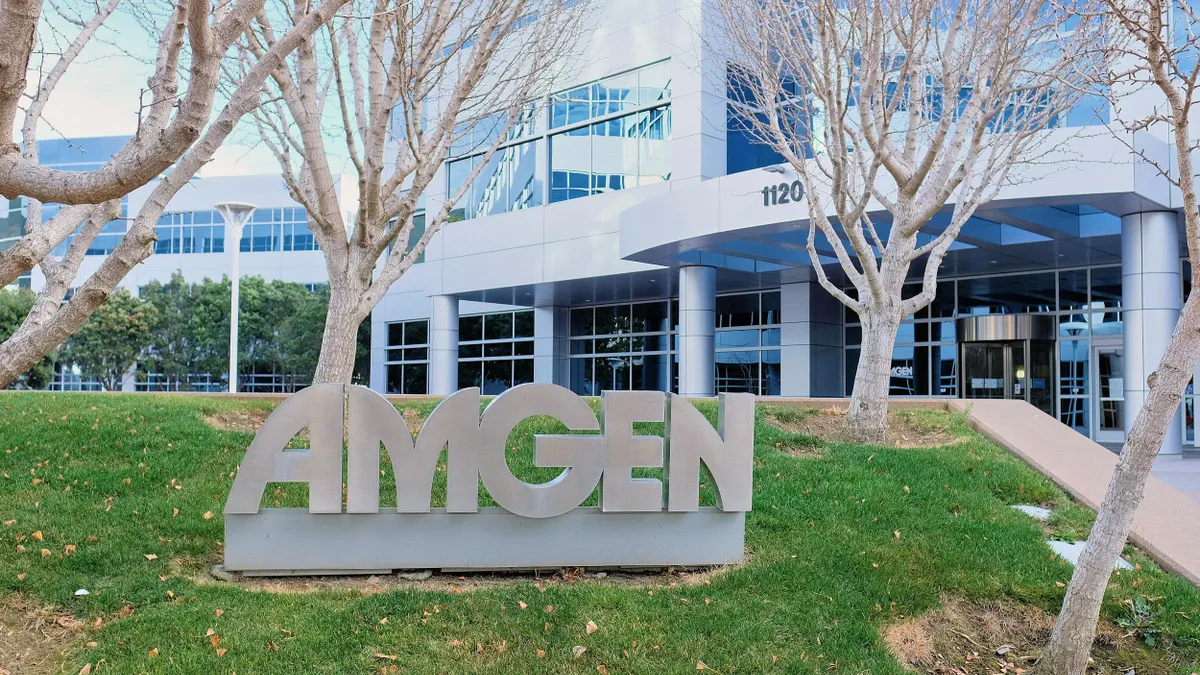
When the FDA granted Amgen’s KRAS drug Lumakras accelerated approval in 2021, it marked a milestone moment for a target once deemed undruggable.
For decades, scientists knew that mutations of the KRAS gene accelerated several deadly types of cancer, but the resulting protein’s smooth surface repelled all the drugs they threw at it. Amgen scientists identified and exploited a critical weakness: small, previously unrecognized pockets that allowed Lumakras to bind to the protein and flip the off switch, according to I-Fen Chang, vice president of oncology global development at Amgen, in an email.
Despite the excitement surrounding its launch, Lumakras has seen modest commercial success, largely due to a limited patient population and reimbursement challenges, especially in markets outside the U.S., said Neha Anand, an analyst at Citeline.
The subsequent 2022 approval of a second KRAS drug, Krazati, which is now owned by Bristol Myers Squibb, also eroded Amgen’s market-leader advantage. Even so, Lumakras continued a modest but steady climb.
“Lumakras continued to grow in 2025, with fourth quarter sales increasing 8% year over year to $92 million and full-year sales rising 4%,” Chang said.
At the same time, the focus on new KRAS options is intensifying with the next wave taking shape. Lumakras and Krazati face rising competition from second-generation KRAS options that appear poised to optimize the existing lineup and target other subtypes that are more common in pancreatic and colorectal cancer. There is also the potential for combination approaches to overcome resistance and improve efficacy, Anand said.
“We are seeing trials testing KRAS inhibitors in first-line settings [and] in combination with other immunotherapies,” she said. “Several regulators are also responding quickly.”
Second generation rising
Both Lumakras and Krazati target the KRAS G12C mutation, which is most common in non-small cell lung cancer, and have also notched approvals as combination therapies for certain types of colorectal cancer. While these drugs have become critical tools in the oncology arsenal, only about 30% to 40% of patients respond to them, and they’ve extended median progression-free survival by about six months, at which point drug resistance often sets in, according to a review article in Nature.
Other types of common KRAS-driven cancers, including pancreatic and colorectal cancer, are often driven by different protein subtypes, including KRAS G12D and KRAS G12V, so companies are now zeroing in on those targets. Oncologists rely on precision tools to tailor treatments to a patient’s tumor type, so expanding options to treat these mutations is crucial.
Amgen is among those advancing new KRAS options. Not only is the company continuing work on Lumakras in hopes of moving the drug into earlier lines of therapy, but it’s testing it in combination with drugs such as Vectibix, Folfiri and chemotherapy in colorectal and lung cancer.
“We are also actively developing a pan-KRAS inhibitor, AMG 410, designed to target multiple KRAS mutations beyond G12C,” Chang said.
But they have significant competition in R&D. Roche is advancing what experts say is a potentially more potent G12C option, divarasib. In patients with non-small cell lung cancer, the investigational drug produced an objective response rate of more than 55% and median progression-free survival of almost 14 months across all dose levels.
Eyes are also on Merck & Co.'s calderasib, a KRAS G12C inhibitor being tested in multiple phase 3 trials and Lilly’s phase 3 G12C drug olomorasib. Lilly is also in early-stage trials with a KRAS G12D inhibitor and a pan-KRAS inhibitor.
Other companies are tackling KRAS mutations via a slightly different approach. Revolution Medicines, received the FDA’s breakthrough therapy and orphan drug designations for its RAS(ON) multi-selective inhibitor daraxonrasib, which targets multiple RAS variants simultaneously. The drug, being tested in pancreatic cancer, generated a significant patient response rate in early-stage trials.
Combination approaches could also help overcome drug resistance.
“Some companies like Amgen and BMS are running combination trials pairing these KRAS inhibitors with EGFR antibodies to suppress the signaling and to get a better benefit, or better efficacy,” Anand said.
Proving value
If they do make it to market, these new products will need to distinguish themselves in a crowded market that could reach $3 billion to $4 billion by 2028, Anand said.
“Payer scrutiny is always on cost versus durability,” she said. “I think it will be a very competitive space and we need to keep an eye on the clinical trial readouts that demonstrate superior durability, safety or efficacy.”
It’s likely that patients will gain new treatment options in the next two to three years, Anand said.
“They'll have better drugs and better combination therapies, which will target the disease more effectively. And I think colorectal cancer will be the fastest growing segment,” she said. That disease is currently seeing a sharp increase in challenging-to-treat, young-onset cases.
“I think KRAS is going through one of its most exciting shifts in the oncology field,” Anand said.