There’s little doubt that Daiichi Sankyo has carved out a stronghold in the market for antibody-drug conjugates. Buoyed by its roster of ADCs, the company’s first-quarter revenue rose 21% over the year before. Daiichi also raised its full-year revenue and operating profit guidance in July.
But a question is hanging over Daiichi’s future trajectory: Will the company have more tricks up its sleeves in oncology?
So far, Daiichi’s backbone has been built by its DXd ADC platform, which has spawned two marketed therapies.
First came AstraZeneca-partnered Enhertu, which was launched in 2020 for HER2-positive unresectable or metastatic breast cancer. The ADC has since soared to blockbuster status, racking up more approvals in additional breast cancer settings and other solid tumors.
Daiichi expanded its ADC empire in 2025 with an approval for Datroway in HR-positive and HER2-negative breast cancer. The drug later won U.S. approvals in EGFR-mutated non-small cell lung cancer and metastatic triple-negative breast cancer, becoming the first TROP2-directed therapy approved in the lung cancer setting and the first TROP2-directed ADC approved for first-line treatment of certain patients with metastatic TNBC. In fiscal 2025, Datroway generated roughly $300 million in global product sales.
And three other DXd candidates are waiting in the clinical wings across indications including lung and ovarian cancers and other solid tumors.
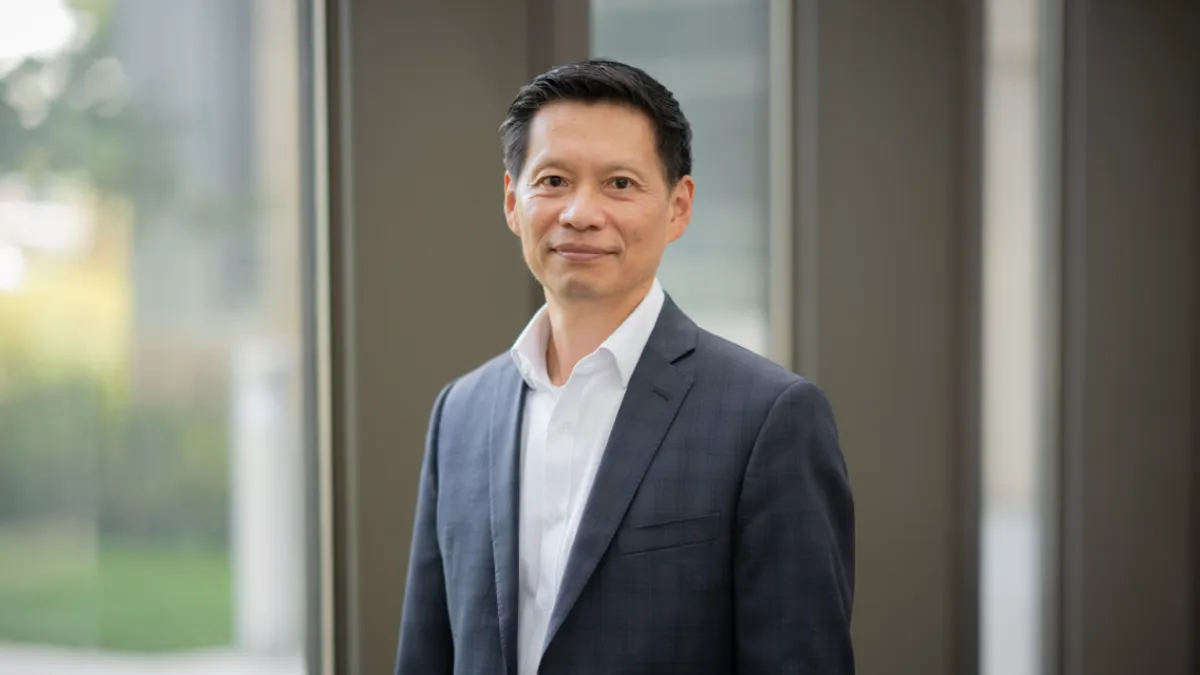
But as Daiichi moves toward its next horizons, there’ll be more to the story than its DXd platform, according to its global head of R&D, Dr. John Tsai.
Tsai came aboard Daiichi this year after stints at large pharmas including Bristol Myers Squibb, Amgen and most recently, Novartis, where he steered development for 160 new projects and 500 clinical trials, according to Daiichi. Although Daiichi’s pipeline is not the largest he’s managed, Tsai said it is the “most innovative.”
Tsai’s mandate in the role is to push Daiichi towards new frontiers in oncology as it aims to become a “global top five oncology company” by 2035. It’s a goal that will require developing not just new types of ADCs but other technologies, many of which could be used in combination with ADCs as well.
This week, Daiichi announced an R&D collaboration aimed at exploring that combo approach. With its long-time partner AstraZeneca at its side, the companies are teaming up with Summit Therapeutics to test its closely watched PD-1/VEGF bispecific ivonescimab in combo with Datroway in multiple tumor types.
Daiichi’s aggressive push in multiple directions in cancer has also hit speed bumps.
On Sept. 25, Daiichi and partner Merck & Co. pulled their FDA accelerated approval application for the clinical DXd candidate ifinatamab deruxtecan after discussions with the agency determined the companies’ supporting data were insufficient for approval.
Here Tsai explains Daiichi’s long-term cancer development strategy, why its pipeline is competitive, and what he’s learned from weathering clinical setbacks.
This interview has been edited for brevity and style.
PHARMAVOICE: What is your strategy for developing the next wave of ADCs? Are you aiming for another platform approach like you have with DXd?
DR. JOHN TSAI: It's a multi-pronged approach. We have 12-plus years of research capabilities that have been built in the ADC space, and we are already looking at the next wave of ADC approaches. Whether that would be to overcome resistance to the existing ADCs, or to think about different linker and payload technologies for ADCs.
Beyond that, we are also looking at combinations that include novel approaches in immunology, and could be small molecules, bispecifics or multispecifics. We could either combine these with our own ADCs or combine with existing agents in the marketplace.
And beyond that, we also have other platforms we’re looking at, including a targeted protein degradation platform.
What people know us for is our ADC approach, but we have a lot of research and biological understanding in the various tumor types where we want to expand.
You brought up the linker and payload technologies. How important is it going to be to develop new payload biology in order to develop more effective ADCs?
There's really been two specific payloads that companies are using, and the one we've been advancing is the topoisomerase payload, and many are using that as the mainstay. And it seems like it's the one that's one of the two most efficacious ones. But we are looking into the next generation of payloads. It's always the challenge of finding the right balance between the benefit and risk. How much efficacy can you get versus how much safety? And that's what we're really trying to figure out.
And where are you currently at in those development efforts?
Many of those programs are currently very close to first-in-human trials. But we have some really good ideas and foundations on how to move forward with those.
Some analysts have raised questions about whether the ADC landscape has become too competitive for Daiichi to stay as successful as it’s been. How would you respond to that?
With our DXd ADCs, between now and let's say 2029, we have 20 phase 3 programs that are reading out in nine different tumor types. Not only do we have Enhertu and Datroway, we also have three other ADCs with different targets. So in total, we have several different DXd ADCs that we're advancing as a pool. That would be the first wave of ADCs.
Beyond that, many of our immunology assets are in phase 1 and could be combined with our existing ADCs. So over the next three to five years, we're going to be seeing the advancements of our novel IOs combination approaches moving forward.
Then, if we look beyond the five-year time frame, these are some of those next-generation ADCs with the novel payloads that we talked about, which are currently in preclinical stages, but will be going into humans very soon. I would call this the third wave of innovation from Daiichi Sankyo.
When it comes to the competitive dynamics, there has been a lot of excitement, particularly in the area of non-small cell lung cancer, and tremendous progress made with PD-1s … and there's also been a lot of news around the PD-1/VEGF bispecifics … and people have said, "Hey, maybe Daiichi has been a little bit slower in advancing?” But in fact, many of those studies have been from China, where they need to expand into global studies for us to really see the full potential of these combinations.
The seven phase 3 clinical programs that we have are actually all global studies that started a number of years ago that would allow us to look at first line non-small cell lung cancer for PD-L1 high and PD-L1 low, and we have combinations with Datroway that would be for EGFR-mutated patients in combination with the current standard of care or a single agent. So the existing global clinical programs that we'll be reading out will give us a lot of insights about certain ADCs, whether to use a biomarker, whether to combine them, etc.
What have you learned from the clinical setbacks you’ve experienced throughout your career?
Obviously, with unique biology, there is higher risk. So you have to figure out how you can get early signals to know if the drug would change the way that we treat specific tumor types. Many scientists, including myself, believe that we can solve the answer by just having more time. The current reality of drug development is that yes, you can try to do that, but the competitive landscape doesn't allow you to do it. So, how do you figure out a way to understand whether there is a signal for you to develop a drug? And if not, how can you move on to the next opportunity?
The other lesson learned is that the current landscape requires you to figure out how to move quickly once you see that signal. There are a lot of opportunities for this. One is how do you design your clinical trial? What are the inclusion and exclusion criteria that you set? How do you use biomarkers? Where or how do you use AI?
We need to embrace AI. I've seen the analytic capabilities of what it can bring. I don't think it will replace clinical trials, but I think the information that we gather from AI can speed up the way that we think about how we develop our trials and allow us to drive faster drug development.
Have you had any “holy cow” moments when using AI where you suddenly realized it was more powerful than you previously thought?
Yes. We had been thinking about one of the unique pathways for one of our new drugs, and we spent a lot of time with researchers and people with biologic expertise. Then we plugged all of the information into an AI tool and it gave us a couple of hypotheses about its unique mechanisms that could work in oncology that we hadn't even thought about. These were ideas that may have been tangentially in our overall framework we were thinking about, but had never made it to the forefront. That was very intriguing and insightful for us.