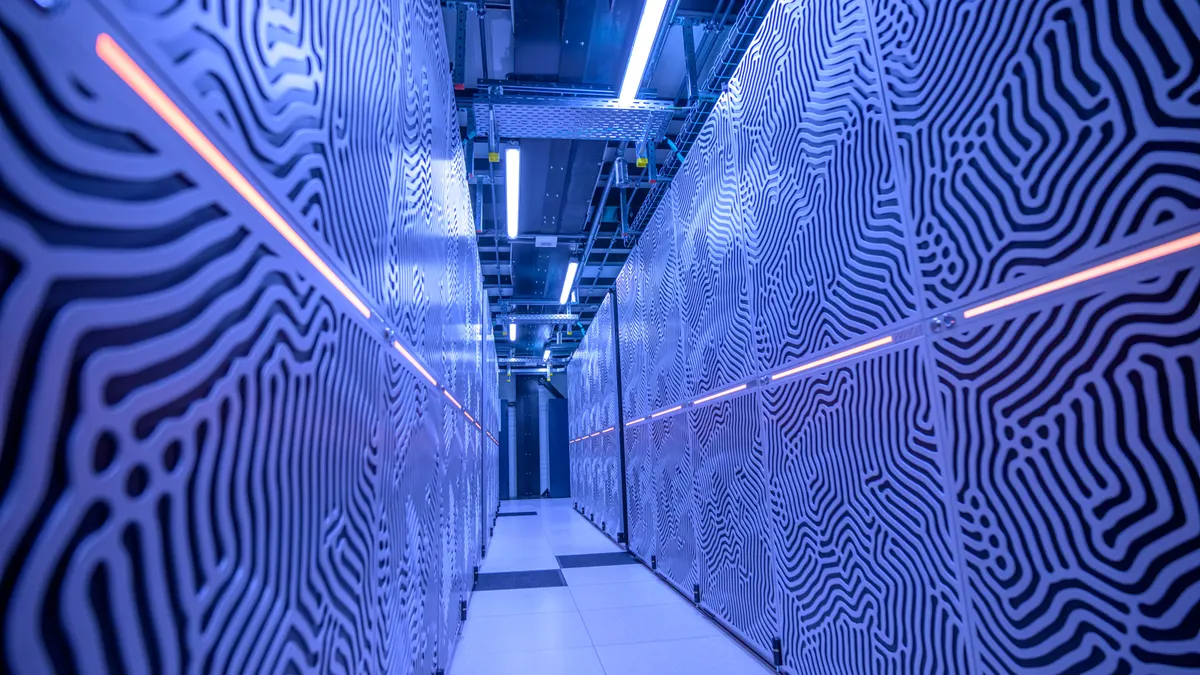
The race to build pharma’s most powerful supercomputer gained a new entrant last month, when Bristol Myers Squibb said a newly expanded partnership with Nvidia would give it “the most powerful and energy-efficient single-owned Nvidia infrastructure in life sciences.”
BMS is the latest Big Pharma to stake an AI-computing superlative claim along those lines. Eli Lilly said in October it would work with Nvidia to build “the most powerful supercomputer owned and operated by a pharmaceutical company.” In March, Roche said an expanded Nvidia collaboration gave it “the pharmaceutical industry’s largest announced hybrid-cloud AI factory,” with more than 3,500 GPUs (graphics processing units).
But the companies are using different yardsticks when it comes to measuring what’s considered the “most powerful.” By Nvidia’s measure of operations per second, BMS’ planned system will be “the most advanced supercomputer in the biopharma industry,” said Rory Kelleher, senior director of business development for life sciences at Nvidia.
“There are other pharma companies that measure it by the number of GPUs [or] that measure it by one single system,” he said.
Whatever the metric, the companies are chasing the same prize: more computing power to train larger models, run more complex experiments and make drug discovery and development faster and more efficient. And they all need more AI power to do it.
“It’s [about] training larger and larger models on larger data sets that therefore give [the system] better predictive and generative capabilities,” Kelleher said. “You can take existing experiments and do them faster, yes. But I think more importantly, you can do experiments that you wouldn't otherwise be able to do by having access to more compute.”
How BMS plans to use the system
BMS has worked with Nvidia for nearly three years and said its AI investments are beginning to pay off in its pipeline and operations.
For instance, Mike Ellis, senior vice president and head of BMS’ discovery and development sciences organization, told PharmaVoice last year that AI helped the company overcome a “plateau” while searching for a clinical candidate for a sickle cell program based on targeted protein degradation.
Under the expanded deal, BMS will deploy Nvidia’s DGX SuperPOD supercomputer with DGX Vera Rubin NVL72 systems, which will deliver up to “ten times greater performance per megawatt than its predecessor,” BMS stated.
Overall, the setup will create “the most performant supercomputer in the biopharma industry,” Kelleher said.
Demand for that accelerated computing power reflects “a convergence of a few different technology trends,” including the rise of AI agents, he said.
“Agents are getting to the point where they can now actually do work. And just on that premise, agents require compute. The more compute you have, the more agents you can spin out, therefore the more work you can do. And so they believe that this is an opportunity to drive greater efficiency into the early discovery process,” he said.
More computing power alone is not enough; the agents also need tools built for the scientific domain, Kelleher said. BMS will pair the supercomputer with Nvidia’s BioNeMo Agent Toolkit.
“This is a collection of accelerated tools, models [and] libraries that are turned into agent skills,” he said. Giving a general-purpose agent access to the toolkit allows it to perform scientific tasks within BMS’ “hybrid intelligence” model, which pairs researchers with AI agents, Kelleher added.
The companies expect the system to be “live and available” to BMS researchers in the first quarter of 2027, Kelleher said.
The rest of the AI stack
Supercomputers are only one layer of pharma’s AI strategy. Drugmakers are also striking targeted deals for models, software and specific R&D and clinical applications.
This year alone, BMS struck deals with Anthropic to deploy Claude across R&D and global operations; Microsoft to advance AI-powered early lung cancer detection; and Evinova to use AI to improve clinical trial design, timelines and costs.
Similarly, Eli Lilly struck a drug discovery collaboration with Insilico Medicine worth up to about $2.75 billion, while Roche paid $55 million upfront to use Manifold Bio’s technology to develop new “shuttles” that can carry medicines across the blood-brain barrier.
Nvidia, meanwhile, sees an edge in the breadth of the systems and development software it offers alongside its hardware, Kelleher said.
For drugmakers, however, the more meaningful benchmark will be whether all that computing power translates into better R&D decisions — not which company makes the biggest claim