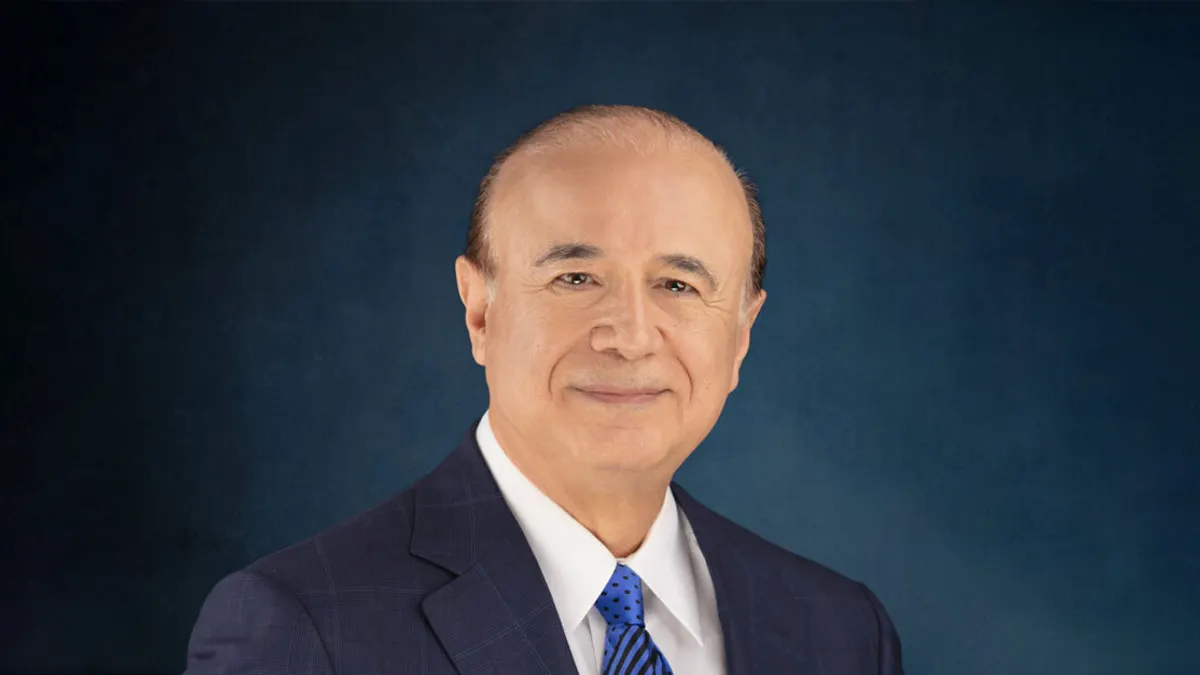
Welcome to “Trailblazers,” a series featuring pharma leaders who’ve carved new scientific and business paths for the industry. Today, we’re featuring RadioMedix founder and CEO Dr. Ebrahim Delpassand, whose early efforts in radiopharmaceuticals helped pave the way for a medical field now being embraced by Big Pharma.
Sometimes, a leader with persistence and a vision can be the catalyst for important new therapies. For the field of nuclear medicine, which now has several approved therapies and diagnostics for cancer patients in the U.S., that leader is Dr. Ebrahim Delpassand.
Radionuclear therapies have been used in medicine for the better part of a century, starting with the discovery that thyroid diseases could be treated with radioactive iodine. The concept was simple: The thyroid metabolizes iodine naturally, so the irradiated version is able to infiltrate the organ easily and kill cancer cells without causing much harm to other areas of the body.
Over time, and especially the last couple decades, the field has evolved to include more targeted therapies that are effective against several types of cancer. What was once a promising but relatively small offshoot of the industry’s wider oncology R&D efforts has become catnip for investors and Big Pharma alike.
Behind many of the advances over the last 20 years was Delpassand, now founder and CEO of the nuclear drugmaker RadioMedix. Treatments and diagnostics he’s been involved with have become available for painful bone metastases, neuroendocrine cancers and prostate cancer.
“To me that’s a testament to how far we’ve come,” Delpassand said.
For patients with cancer and nowhere else to turn, radiotherapeutics offer an option that hasn’t always been widely accepted or accessible until recently, and Delpassand has helped usher in its new era.
“Whatever has been done for patients in the last 20 years has not been successful — we lose patients in two years maximum, and they go through a lot of the systemic chemotherapy, surgery, external beam radiation therapy, and still we aren’t successful,” Delpassand said. “Targeted radionuclide therapy or combinations could really help these patients.”
Building momentum
Delpassand started his medical residency in the 1980s at Baylor College of Medicine in Houston with a focus on anatomical and clinical pathology. That’s where he got a first peek into the world of nuclear medicine.
“I was always fascinated by the therapeutic application of nuclear medicine — first through the functional information provided by diagnostic tests, and then as a way to reach and irradiate a tumor in a noninvasive way,” Delpassand said.
Early nuclear therapies, he noticed at the time, were much less invasive than standard-of-care chemotherapies. But they weren’t getting the attention he thought they deserved.
Delpassand joined MD Andersen Cancer Center in 1992, where he launched the Department of Nuclear Medicine and led it for more than a decade. Even then, while treating patients with limited therapy options, he saw a future in radiotherapeutic drug development. Upon leaving Andersen, he founded the Excel Diagnostics and Nuclear Oncology Center, also in Houston, where he continues to serve as chairman and medical director. Excel leads clinical trials and offers patient services in nuclear therapy.
At Excel, Delpassand said he was the first to bring the radioligand treatment lutetium dotatate to U.S. patients in 2010 — it had taken him three years to convince the FDA it was a viable treatment. And for four years following the agency’s go-ahead, his team held the only IND allowing use in American patients, who would otherwise have to go to Europe to receive it.
The treatment, purchased by pharma giant Novartis and later called Lutathera, was approved by the FDA in 2018 to treat neuroendocrine tumors.
Excel repeated the effort with another radiotherapy, lutetium vipivotide tetraxetan, which was being developed by Germany’s ABX and later U.S.-based Endocyte. Delpassand conducted another successful U.S. trial, again allowing the only access for American patients, manufacturing 1,200 doses for the study and distributing to 48 states and Canada.
That treatment became Pluvicto, also now owned by Novartis, which achieved blockbuster sales in 2025. The treatment sparked Novartis’ Super Bowl ad for prostate cancer blood tests this year.
“We were proud to essentially pioneer this, and for it to be a success story,” Delpassand said.
Only a few years after launching Excel, Delpassand also founded RadioMedix, which began building a pipeline of its own in diagnostic and therapeutic radiopharmaceuticals, mostly in oncology. The company’s lead diagnostic is copper dotatate, called Detectnet, approved by the FDA in 2020.
Now, Delpassand says RadioMedix is tackling unmet needs in difficult areas like pancreatic cancer and brain tumors. The company has two mid-stage drug candidates in neuroendocrine and prostate cancers, as well as diagnostics in mid- to late-stage development.
Because radiotherapeutics have different characteristics to many other treatments — notably radiation — the company has worked across the entire supply chain to support its pipeline, from discovery to preclinical and clinical studies and then commercial manufacturing. Many other drugmakers outsource these operations.
And despite some early fundraising and an equity investment from the state of Texas, the company has self-financed through licensing agreements, as well as Delpassand’s personal contributions. From 2006 to 2011, he was fully funding the cost of his own research.
“Whatever I made in the clinic, I would burn it upstairs in the radio lab,” he said. “We are one of the few drug development and R&D companies without any long-term financial debt.”
Overcoming challenges
Some of the greatest challenges in nuclear medicine have nothing to do with safety or efficacy — instead, factors like supply and sales have hindered promising treatments like GSK’s Bexxar and Spectrum Pharmaceuticals’ Zevalin, both approved to treat lymphoma. Bexxar was taken off the market because of disappointing sales, while access to Zevalin, which was sold to Acrotech Biopharma in 2019, is severely limited.
Availability of isotopes has limited the field in some ways, but Delpassand has seen that grow over time. Supply of materials like actinium-225 and lead-212 is on the rise, as well as diagnostic-ready isotopes like copper-64, gallium-68 and fluorine-18.
The regulatory piece of the puzzle was also hard fought. Delpassand credits his communication with the FDA, even though it took years to get through, for today’s regulatory acceptance of the fundamentals of nuclear medicine.
“FDA now has a wealth of knowledge gained in the last 20 years, but there are still some areas we can improve to expedite what we’re doing,” Delpassand said. “Some preclinical requirements might not be needed when we understand the effects of the drug, for instance. I highly respect what the FDA is doing, but there are certain reforms that help move this forward.”
Big Pharma has signaled its own acceptance of nuclear medicine. At one time, investment was difficult to find. Now, RadioMedix works with pharma titans like Sanofi and AstraZeneca on some of its pipeline programs. Novartis has built an entire pillar of its business on radiopharmaceuticals. AstraZeneca and others like Bristol Myers Squibb and Eli Lilly have made nuclear medicine part of their M&A strategies.
With the growth of nuclear medicine as an established field in pharma, Delpassand said researchers are now working with different types of antibodies to develop targeted radionuclear therapies.
“If these targets are specific to cancer cells and their metabolic pathway, [they] go in like a silver bullet, reaching the tumor and irradiating inside the body while also preserving function of other organs,” Delpassand said. “That’s how targeted radionuclide therapy works, and we’ve come a long way.”