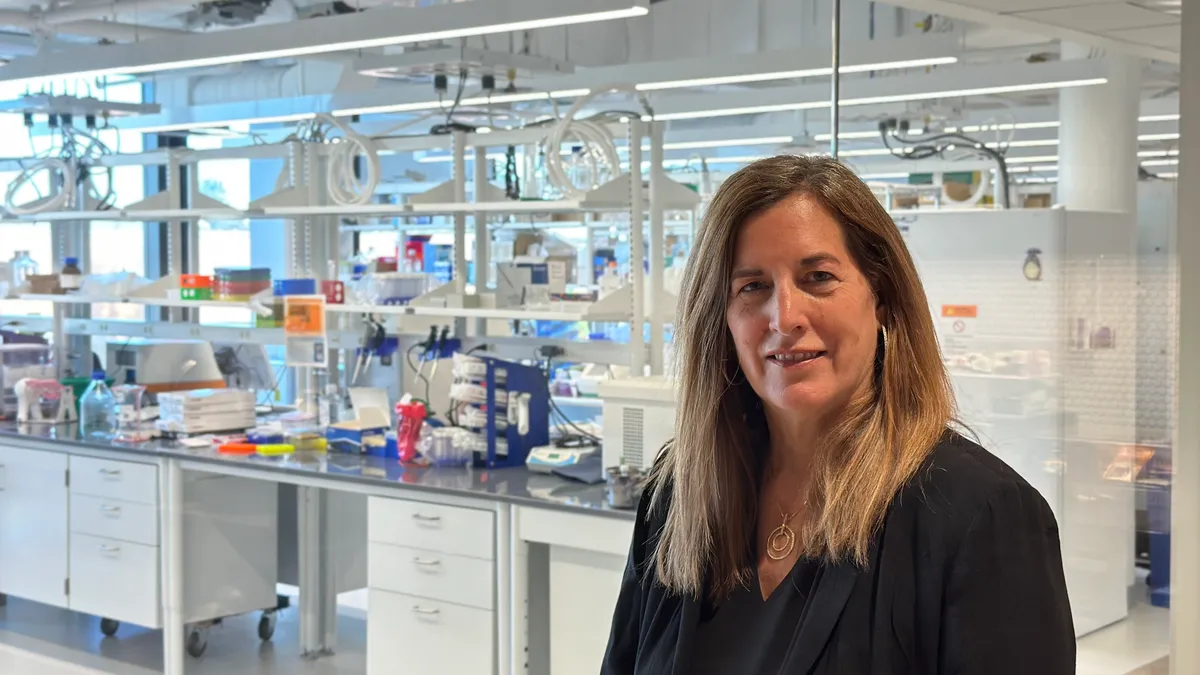
Welcome to First 90 Days, a series dedicated to examining how pharma executives and other leaders are planning for success in their new roles. Today, we’re speaking to Meg Alexander, who just took over the top spot at Ovid Therapeutics and is aiming to guide the biotech through the clinic with two programs in CNS.
Drug development in neurology is always risky, and the stakes get even higher when working with a brand-new drug. That hasn’t stopped Ovid Therapeutics from pressing ahead with first-in-class therapies for challenging brain disorders.
Since its 2014 launch, Ovid has maintained a particularly staunch commitment to epilepsy, a condition with dozens of approved medicines but high levels of lingering unmet need. And now Ovid is depending on a fresh face at the helm to guide the business to market and beyond. Meg Alexander, the company’s former chief operating officer, took over as CEO at the start of year after Dr. Jeremy Levin stepped down from the top spot.
Currently, Ovid’s lead candidate is being developed for drug-resistant epilepsies and is cruising toward phase 2 trials after an earlier-stage study hit the safety mark.
Thanks to the novel target at the center of another program called KCC2, Ovid believes it’s also developing groundbreaking candidates that will finally move the needle on a range of neurodegenerative diseases.
“KCC2 could be a revolutionary target with almost infinite possibilities,” said Alexander.
As Ovid knows, however, big swings can lead to big misses.
The company’s former lead candidate soticlestat looked poised to make a blockbuster impact in epilepsy after promising mid-stage data. But the novel cholesterol 24-hydroxylase inhibitor ultimately failed in phase 3, prompting Takeda Pharmaceuticals, which had licensed the drug, to shelve plans to seek approval. Ovid had been in line for over $600 million in milestone payments from the drug.
Ovid was also in the hunt to bring forward a novel ROCK2 inhibitor for a rare brain disease. But after rival biotech Recursion revealed mixed results for its candidate targeting the same condition, Ovid paused its own program.
For now, Ovid mostly has the KCC2 arena to itself.
The company first tested the KCC2 waters with OV350, which had a clean safety record in a small study, Ovid announced in December. Its next move will be OV4071, an oral KCC2 treatment it hopes to usher into human trials this year. Because of its antipsychotic activity, Ovid plans to test the drug in Parkinson’s disease psychosis and Lewy body dementia. But schizophrenia and other psychosis-related conditions could come next.
“Our goal is pretty audacious,” Alexander said. “We want to bring new mechanisms of action to the brain because patient communities haven’t had that much and they need it.”
Ovid is also leaning into a biomarker-driven approach to de-risk R&D. The company released positive topline results from what it described as the “most extensive biomarker program in early seizure drug development” for its epilepsy drug OV329 in October.
With enough cash runway to last into 2028, clinical milestones expected in the next few years will reveal if Ovid might finally make its mark.
Here, Alexander explains Ovid’s goals in neuroscience R&D, the potential rewards it could bring and how her experience in drug launches helps her develop strategies for navigating clinical trials.
This interview has been edited for brevity and style.
PHARMAVOICE: How are you balancing the risk of neuroscience R&D in your pipeline?
MEG ALEXANDER: In neurology there is more risk, so we have always made the choice to be a company with a multiple-medicine pipeline.
We’ve taken risks on different mechanisms of action, which the field needs. Neurology has been a field of sameness. In seizures, for example, there have only been a few new medicines, which isn’t much when you [compare it to] the cancer space. That can be a challenge from a scientific perspective.
On the other side, we have programs that are differentiated and aimed at exciting target areas. KCC2 is now becoming more de-risked, and we hope it will be the step change for patients who have not had new mechanisms. There are a lot of patients with seizures, for example, who are not well served — or even if they are, their quality of life is poor. So our other goal with developing small molecules in neuroscience is to make medicines that are better but also gentler.
Why do you characterize KCC2 as a “revolutionary target”?
We are finally entering an era of precision neurology and psychiatry and KCC2 is one of the most exciting targets in the brain. This is a bold statement, but I believe that drugging and directly activating KCC2 could be equivalent to a PD-1 inhibitor-like moment in cancer in terms of its broad applicability.
KCC2 balances potassium and chloride in your brain, and when it’s not working, GABA can’t do its job. It’s a master switch in neuro excitability that’s either directly related to underlying disease or the worst symptoms of underlying aspects of disease — from Parkinson’s psychosis and hallucinations to schizophrenia.
How are you approaching development for this new type of drug?
Data on OV350 was a big deal not just for Ovid but for the field of neuroscience because we categorically showed you can safely drug and activate KCC2, which [matters] with a new target and mechanism of action. So that was our tool program and we got a lot of great de-risking information from it.
Looking ahead, we believe the opportunity we have for OV4071 is profound. The first indication we chose is Parkinson’s because it has risk-mitigated attributes for development. There are clear endpoints and a regulatory path, and you can easily identify the patient population. But there’s opportunity for OV4071 in Alzheimer’s hallucinations and psychosis, schizophrenia and Rett syndrome — conditions that have had few mechanistic innovations in the last 20 to 30 years.
Your bio suggests you’ve spent more of your career working on launches than clinical development. How will your experience help guide a clinical-stage company?
The main thread of my career has been asking critical questions that help medicines advance to the next step. Before joining Ovid, I spent about 15 years consulting companies and helping them pioneer first-in-the-space modalities. So that meant every time we were getting ready for launch, we were laying down tracks where no one had before. So my career has been about strategically solving challenges and finding opportunities.
And there is something uniquely special about working with a new medicine and getting it across the finish line, but also working with teams that have to metamorphose and grow. Going from development to commercial means constant evolution. People take for granted the challenge of that, but when you can do it, it’s not only an achievement but helps build the overall strength of the organization.