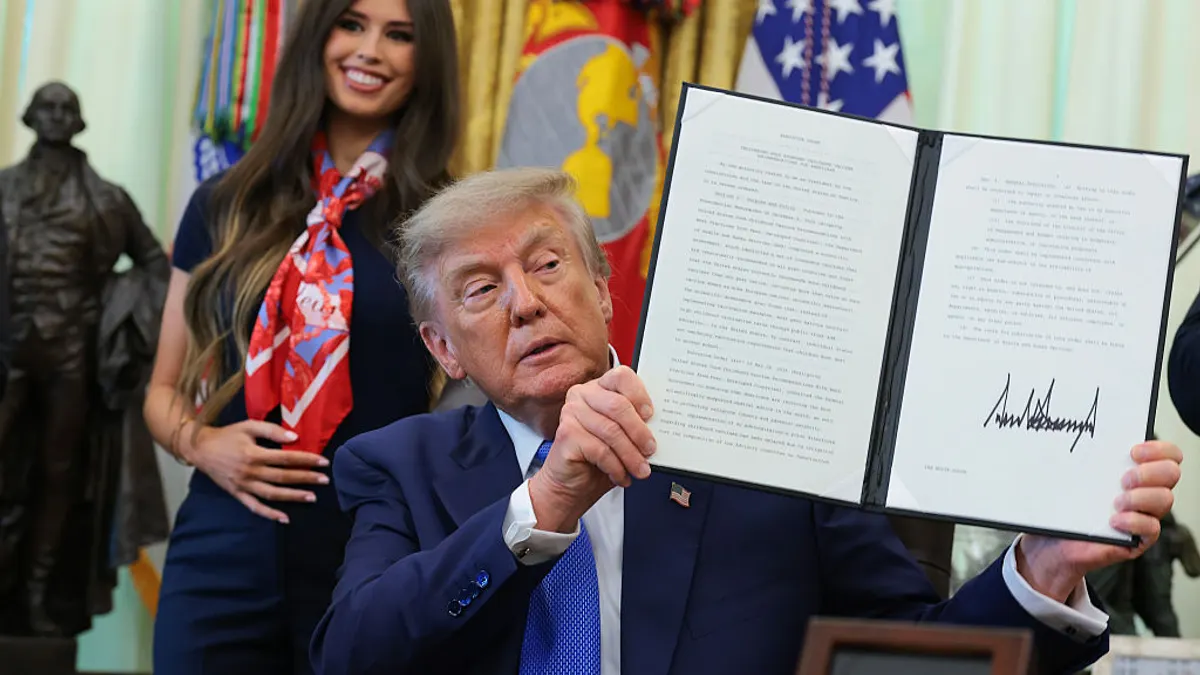

President Donald Trump has revived his administration’s attempts to alter the U.S.’ longstanding childhood immunization schedule, signing an executive order on Monday meant to narrow the number of vaccinations kids receive and space those shots out among more medical visits.
The “Gold Standard Childhood Vaccine Recommendations” order Trump signed Monday calls for lowering the number of universally recommended shots to 11 from 17. It also states that the MMR vaccine should be split into three separate shots once available domestically, directs all childhood vaccines to be administered at separate appointments, and asks a Health and Human Services Department task force to come up with a plan to adjust the overall schedule “as appropriate” within 90 days.
At a press briefing in the Oval Office, Trump said the order “finally aligns the United States with other advanced and developed nations around the world.”
“More importantly, it aligns us with common sense and knowledge,” he claimed.
The administration didn’t provide any new scientific evidence in support of the proposed changes, which were made with the help of the president’s advisers and go against established science. It’s also unclear what kind of authority the order has. Alterations to vaccine policy are made through recommendations of an expert Centers for Disease Control and Prevention panel that are ratified by the agency. And states, not the federal government, choose which shots are mandatory before children go to school or daycare.
“This executive order is part of a troubling pattern by the administration to attempt to unilaterally change vaccine guidance, particularly for children, rather than relying on the transparent, scientific review that has guided the U.S. childhood vaccine schedule for decades,” said Jan Carney, president of the American College of Physicians, in a statement.
Under the order, immunizations for conditions such as human papillomavirus, pneumococcal disease, polio, pertussis, tetanus, measles, mumps, and rubella remain universally endorsed. But shots for respiratory syncytial virus and hepatitis A and B, among others, are recommended for “high-risk groups.” For those not at risk, those vaccines, as well as immunizations for COVID-19 and influenza, would be offered under “shared clinical decision making.”
The order additionally directs the attorney general to pursue “meritorious” legal challenges against state laws governing religious or medical exemptions.
The move thrusts vaccine policy back into the national spotlight after months of more muted messaging from the administration. Earlier efforts by HHS Secretary Robert F. Kennedy Jr. to change the childhood vaccine schedule were blocked by the courts. And the White House has reportedly taken a more conservative approach in recent months amid fears that publicly repudiating vaccinations — particularly during a measles resurgence — is a losing political issue. Kennedy, for instance, has spent more time in recent months publicly speaking about healthy food than vaccines. And the newly confirmed CDC director, Erica Schwartz, is a supporter of vaccines who promised she would “never betray the science.”
At the White House, health policy adviser Heidi Overton said the order was a response to the court order freezing the administration’s vaccine agenda. Trump claimed to have been driven by concerns over whether vaccines are linked to autism, a theory that’s been debunked by many large studies.
“I’m a doctor. This executive order is wrong,” Bill Cassidy, a powerful Republican senator from Louisiana who heads the Senate Health Committee, wrote on the social media platform X. “The President does not have the expertise to make these changes. Vaccines are overwhelmingly safe. Vaccines are effective. Vaccines DO NOT cause autism. Breaking up vaccines will mean children have to get more shots to get the same protection.”
The administration’s push to narrow the vaccine schedule was built around an assessment led by ex-Food and Drug Administration official and COVID-19 vaccine skeptic Tracy Beth Høeg as well as Martin Kulldorff, a former CDC vaccine panelist who also questioned the safety and effectiveness of childhood shots.
That review determined that the U.S. is a “global outlier” among 20 developed nations in terms of the number of diseases addressed by routine shots and the total recommended doses. It also contended that the current U.S. schedule is at least partly to blame for declining vaccination rates.
Yet the U.S. schedule has been demonstrated as generally safe and effective through decades of research. According to the American Academy of Pediatrics, the policy has also helped save more than 1 million lives as well as trillions of dollars in healthcare costs over the last three decades.
What’s more, the vaccine policies of many nations depend on population demographics, differences in healthcare coverage and the types of disease threats their citizens face. Experts have cautioned that those differences make comparisons to the U.S. schedule misleading.
“Vaccines are one of our most effective tools for protecting public health,” Carney said. “The evidence clearly shows that vaccines are safe and effective at preventing deaths, hospitalizations, and the spread of disease.”