Novavax’s recent matchup with pharma giant Pfizer flipped the script on a pretty downbeat year for the vaccine space. The partnership could also be the start of “much more to come” from Novavax, CEO John Jacobs said.
The biotech’s licensing pact with Pfizer, revealed last week, will leverage its adjuvant vaccine platform in the development of two undisclosed Pfizer products. After pocketing a $30 million upfront payment, Novavax could see another $500 million come its way if the products hit R&D and sales milestones.
The deal also builds on the momentum Novavax generated in 2024 with a Sanofi tie-up centered around COVID-19 and flu shots that could be worth $1.2 billion.
At the heart of Novavax’s recent win sits Matrix-M, a proprietary adjuvant derived from soapbark tree extract.
“Matrix-M can enhance immune performance and reduce the antigen load, which is good from a safety perspective,” said Elaine O’Hara, Novavax’s chief strategy officer.
Matrix-M is also a versatile adjuvant with applicability “across protein and viral type antigens,” O’Hara said, and could work with mRNA-based vaccines, as well. Its broad potential means Matrix-M might also be useful outside of the infectious disease space, where oncology vaccines are poised for market entry.
“We are using R&D in a different way.”

John Jacobs
CEO, Novavax
Although Novavax can’t disclose which companies are currently testing Matrix-M with their vaccines, Jacobs said Novavax is fielding the “strongest interest yet” and has built a “pipeline of potential partnerships” that could result in material or transfer agreements down the road.
“We intend to bring many more deals forward,” he said.
But the company will have to maintain its dealmaking streak in an embattled sector with mounting challenges.
A rocky vaccine market
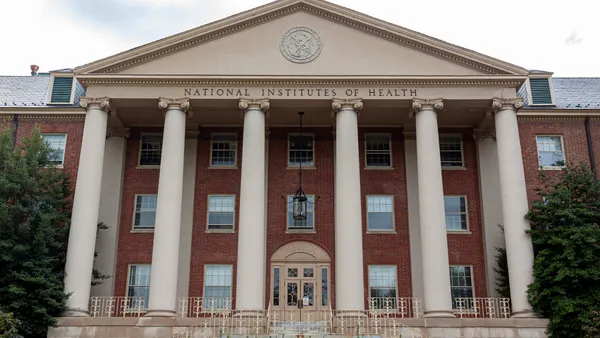
Under the leadership of HHS Secretary Robert F. Kennedy Jr., health regulators have cracked down on vaccines.
After ousting members of the CDC’s influential Advisory Committee on Immunization Practices, Kennedy rebuilt the panel with several known vaccine skeptics. The committee has since issued a string of controversial recommendations, including watered-down guidance for hepatitis B vaccines.
Earlier this month, HHS also announced plans to more closely align America’s childhood immunization schedule with those of other developed countries like Denmark, which only inoculates kids from 10 diseases, compared to 18 in the U.S.
And ACIP continues to raise eyebrows. In a podcast interview last week, the committee’s chair questioned whether polio and measles vaccines were still necessary in a time of improved sanitation and suggested that personal freedom could be a higher priority than public health for ACIP going forward.
The FDA, meanwhile, floated the possibility of drafting more restrictive rules for vaccine clinical trials by requiring real-world evidence over the surrogate endpoints that have long been the industry’s gold standard.
Mounting vaccine hesitancy in the U.S. is taking a measurable toll on drugmakers. Moderna CEO Stéphane Bancel recently blamed the country’s regulatory climate on its decision to stop new investments for phase 3 testing of vaccines impacted by government recommendations for the “foreseeable future.”
Still, Jacobs remains optimistic about Novavax’s prospects, even though the company has had a challenging rebound after its COVID vaccine hit development speedbumps and then failed to gain widespread traction on the market.
“There is uncertainty in the macroenvironment, which has created hesitancy, but not where it matters to us,” Jacobs said.
One of the keys to Novavax’s strategy is maintaining non-exclusivity in deals so that it can partner with a range of companies, Jacobs said.
Novavax will also continue to invest in its own pipeline, which includes late-stage candidates for COVID and flu alongside preclinical assets for shingles and C. diff. But the company’s R&D aims go beyond bringing new products to market.
“We are using R&D in a different way,” Jacobs said. “We’re using it to generate data and additional proof points around Matrix-M. R&D is an evergreen engine to facilitate new partnerships and give us a chance to keep adding partners for years to come.”
The deal with Pfizer may be the kickstart they need.
“It’s a validation of our tech from world leaders who understand the space and have scientific and business experts who know how to value tech like this,” Jacobs said.