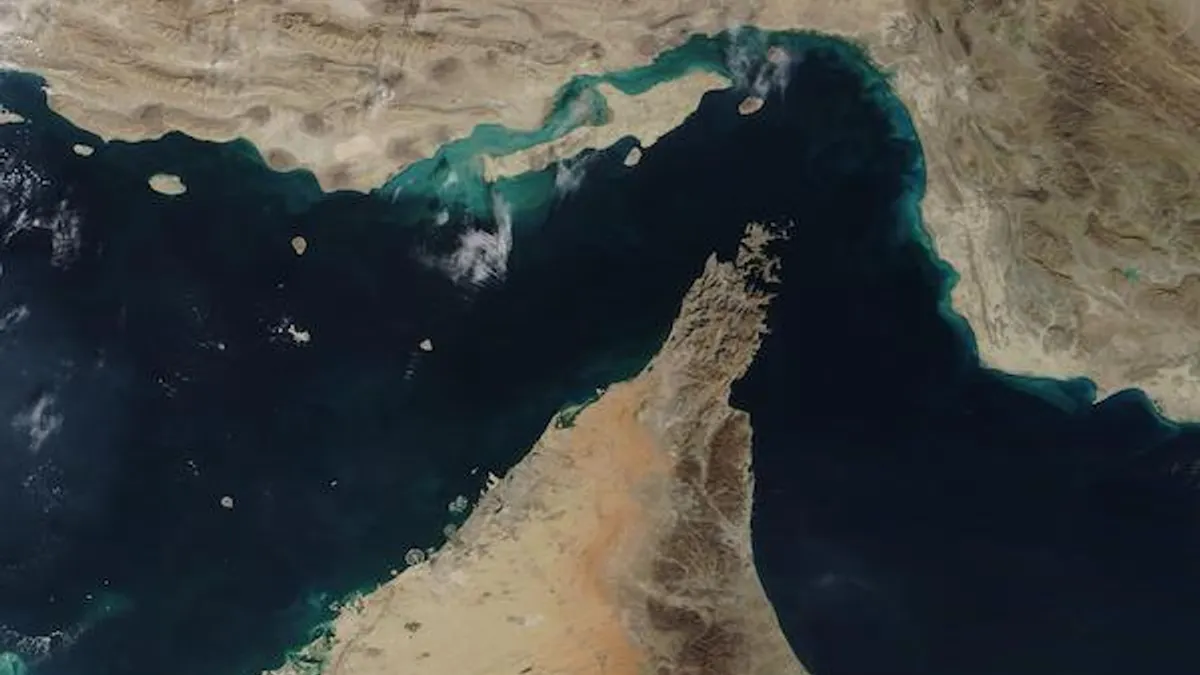
U.S. and Israeli strikes on Iran have pushed the Middle Eastern nation to the brink. But one area where Tehran has held consistent control is the Strait of Hormuz, a critical international shipping lane for many industries — including pharma.
The Persian Gulf waterway is at the center of negotiations to end the conflict, with demands from President Donald Trump that Iran open the strait or face further airstrikes. And while Iran has allowed some Chinese ships through, the otherwise strict blockade has been one of the nation’s most valuable chips since the war began in February.
The blockade, which affects air and ground routes as well, has led many industries to scramble for new shipping routes. Oil prices have soared with the closure of the strait, which normally oversees about one-fifth of the global supply.
Pharma also has had to consider rewriting the manufacturing and transportation playbook to get medicines where they need to go, said Alex Guillen, global SME life science and pharma director at Tive, a shipment tracking and logistics company based in Boston.
“The Strait [of Hormuz] has been a region with one of the biggest investments in terms of logistics — probably one of the biggest in moving cargo east to west ever,” Guillen said. “It’s been the center of attention not just for pharma but for any industry.”
About 10% of global pharma products move through the Persian Gulf shipping lanes and air freight routes, Guillen said. Even more critical, however, are time-sensitive, temperature-controlled ingredients and medicines transported through the area, which account for about 20% of that particular global market, he said.
Even after the smoke settles in Iran and the waterway is back in business, Guillen is concerned investors will think twice about depending on the security of those routes in the future. For drugmakers navigating the changes, the road forward will require adaptability and diversification.
Delays and disruptions
When it comes to products moving through the Gulf, pharmaceuticals are in a high-stakes category of their own, Guillen said.
“If you’re moving televisions, and the televisions are delayed, the consequence is someone will get their television a little later,” Guillen said. “When you’re talking about pharmaceuticals that are life-saving and time-critical, a delay is not simply a delay — it can have consequences for the quality and integrity of the medicine and can eventually hurt patients.”
Now, pharma giants with millions of tons of inventory in the Gulf need to explore new routes to mitigate risk. But with tight regulations around the pharmaceutical industry, those options are limited, Guillen said. And the ramifications of delays and disruptions in shipping don’t apply equally to all regions, he said. Developing countries often bear the burden.
“The problem is that when these kinds of disruptions happen, rich, industrialized countries are affected by 4% or 5% because they’re able to find alternatives,” Guillen said. “The real countries that get affected are poor countries that can’t find quick agreements, and their effect can be more like 95% in terms of disruption.”
For example, Africa and southern Asia, which source many of their pharma products from China through the Persian Gulf, have had to reroute through Western Europe, which can be economically prohibitive, Guillen said.
Where these disruptions hit hardest is clinical trials, Guillen said. Between 1,500 and 2,500 clinical trials have been halted due to the upheaval, which has created an unpredictable environment for drug R&D, according to Tive estimates.
From efficiency to adaptability
The name of the game in manufacturing and distribution for Big Pharma has been to maximize the efficiency — and thus, profit — of large facilities in certain parts of the world. But with one of the largest shipping routes now inaccessible, the mindset has changed quickly, Guillen said.
“The DNA of the manufacturers has been to build a robust structure for distribution that optimizes efficiency, but now that they don’t know what’s going to happen two weeks or two months from now, they have to adjust to change,” Guillen said. “They are no longer optimizing — they are surviving, which means diversifying geographically.”
Disruptions to the east-to-west manufacturing pipeline has led to a wake-up call for companies to manage distribution on a more global level, which reduces their efficiency in the long run.
Can the pharma industry learn any lessons from these geopolitical disruptions? If there’s one important takeaway, Guillen said, it’s that teamwork should thrive in a time of crisis.
“The only way to take care of patients and make sure drugs are delivered on time is to become more versatile with a high level of cooperation, even among competitors,” Guillen said. “Logistics providers, contract manufacturers, pharma companies are working together, even in an industry that is often very conservative.”
Also under the gun are industry regulators who often “pull the handbrake every time there is change,” Guillen said. The relationship between governments and the private sector is critical in the face of change to develop contingency plans, which was a lesson learned just a few years ago during the COVID-19 pandemic, when “cooperation was forced.”
During the COVID health crisis, competitors worked together, manufacturers of temperature-control monitors collaborated and freight forwarding companies came up with solutions that would lift up a global supply chain in need, Guillen said.
“We are seeing this type of disruption more often, and the best way to reduce risk for the future is to take action now by accumulating information and evaluating data,” Guillen said.
For Big Pharma in particular, which operates on a global scale, regional disruptions can lead to broader expansion. Rather than running a “super factory” in one part of the world, they might be incentivized to prioritize security by spreading that business across several regions.
That mindset limits the amount of investment in the industry’s supply chain, though.
“Big Pharma is going to just stop these big investments we’ve seen in the past, and that hurts the whole industry,” Guillen said. “We want companies advancing personalized medicines, cell and gene therapy, digital twins and other innovations that will affect healthcare in the next 10 years, but that might not happen as quickly due to these disruptions.”