Like many patients, Gabby Zappia’s early symptoms didn’t seem too concerning. She was pregnant, so her fatigue wasn't unusual, and her bleeding likely came from hemorrhoids, according to her doctor.
But nine months of persistent challenges finally led the 36-year-old to a colonoscopy and an unexpected diagnosis — stage 4 colon cancer that had spread to her liver.
“I had a feeling that something was wrong, but my symptoms didn't seem serious, and they definitely didn't feel like cancer,” Zappia said at a recent Q&A hosted by City of Hope, where she received treatment.
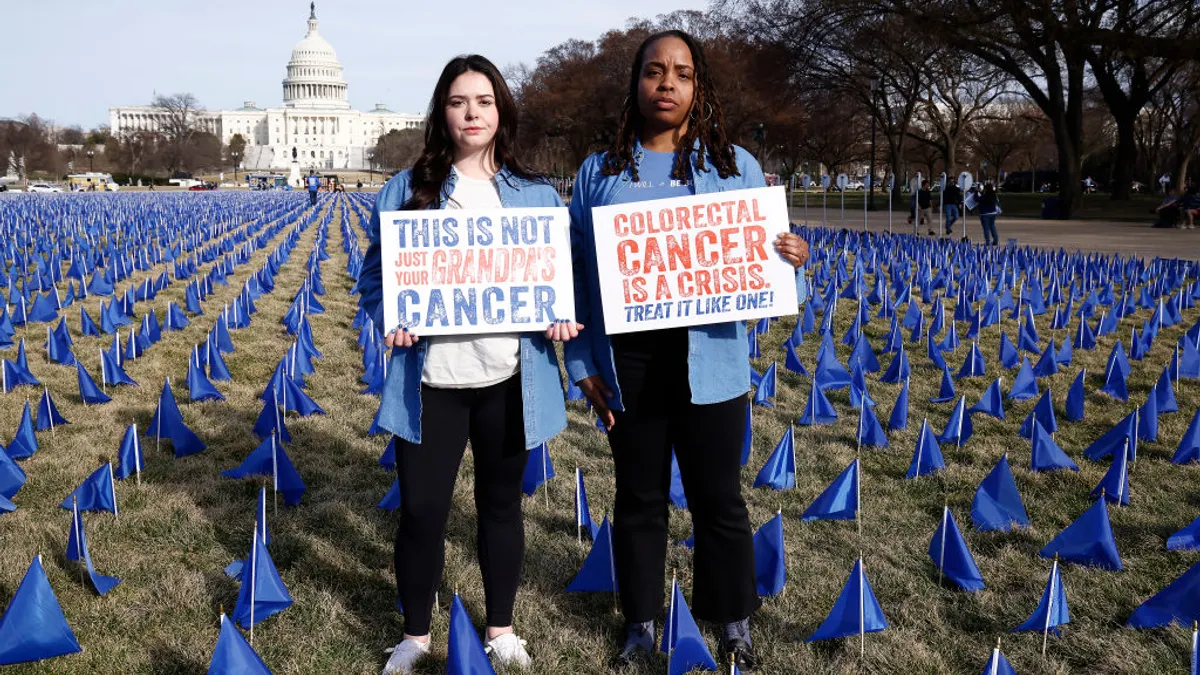
Zappia’s story is becoming increasingly common. While cases of colorectal cancer are dropping in older adults, in part due to screening, about 20,000 cases each year are diagnosed in people younger than 50. The illness is now the leading cause of cancer death in that age group in the U.S. In fact, about 13% of the colorectal cancer population is under age 50, said Dr. Marwan Fakih, deputy director of the City of Hope Comprehensive Cancer Center on the call.
“This is almost double the percentage that we had about 20 years ago,” he said.
The trend is accelerating a shift toward biomarker-driven precision medicine approaches that target specific mutations, particularly in aggressive subtypes, and later-stage disease. Researchers are also developing new, less invasive tests that can be used to screen younger people in hopes of preventing the disease altogether.
A mysterious rise in cases
It’s still not clear what’s driving young-onset colorectal cancers. Suspected risk factors run the gamut from early antibiotic use to obesity, lifestyle or exposure to microplastics. But genetics is thought to drive about 20% of cases, Fakih said.
“There are a lot of factors that have been linked to the rise, but none of them is a smoking gun, as none of them explains the magnitude,” he said.
Early-onset cases present a number of challenges, from later diagnoses like Zappia’s to tumors that often behave more aggressively. Because traditional chemotherapy and radiation can affect both fertility and bowel function, younger patients, who are more likely to develop rectal tumors compared with older adults, face unique hurdles. In response, doctors aim to create treatment plans that attack the cancer while limiting collateral damage in patients who might still want to have children.
Researchers are testing new strategies, including chemotherapy and immunotherapy combinations they hope can diminish the need for surgery and radiation, Fakih said. But more needs to be done.
“A lot of sobering research has shown that despite the fact that young individuals get more aggressive care and more aggressive treatment, outcomes sometimes are worse for these patients,” said Dr. Pashtoon Kasi, medical director of GI medical oncology at City of Hope Orange County, who also spoke at the City of Hope event.
Cancers in younger adults are often found later because routine screening doesn’t start until age 45. Because many of these patients are young and healthy, doctors often don’t suspect cancer. Later-stage disease is more challenging to treat, especially in patients who have tumors with difficult-to-target mutations, such as BRAF and KRAS. A large proportion of these cancers are in fact driven by the KRAS mutation.
“We're doing a lot of targeted therapies. We've developed KRAS G12C inhibitors that have been FDA approved, and now we're looking at multiple studies targeting KRAS in the clinic,” said Fakih. Several KRAS and BRAF inhibitors are also moving through the pipeline.
In February, the FDA approved the BRAF inhibitor Braftovi from Pfizer subsidiary Array BioPharma, for a subset of patients with metastatic colorectal cancer. Another contender showing early signs of promise is Merck & Co.’s calderasib, a KRAS G12C inhibitor being tested in multiple phase 3 trials.
Harnessing immunotherapy
Immunotherapy, which has been a game-changer in many types of cancer, has seen less success in these patients. About 5% of patients with advanced-stage colorectal cancers have tumors with a feature called microsatellite instability, a DNA repair flaw that can lead to a high mutation rate. These tumors are highly responsive to immunotherapy. But the majority of tumors are microsatellite stable, which are not.
“The unmet need in the 95% of patients has been that we cannot really get the immune system to attack and kill the cancer completely,” Fakih said. “We are focusing a lot of our studies to understand how we can get immunotherapy to work better in the advanced-stage disease, and we are also focusing a lot on the targeted therapies in patients with advanced colorectal cancer.”
Second-generation immunotherapy drugs are making a difference in MSS patients, according to Kasi.
“Commercially available immunotherapy doesn't work for these patients, but the next generation of immunotherapies are showing a lot of promising options that are past phase 2 and going into phase 3,” he said.
One is a novel bispecific drug, ivonescimab, a potential Keytruda rival, which is showing early efficacy in MSS tumors and now moving into phase 3.
Combination therapies may also move the needle. One study conducted at City of Hope tested a CTLA-4 antibody, anti-PD1 checkpoint inhibitor combination from Agenus in localized cancers before surgery.
“What was surprising and striking was that not only did we see shrinkage, but the word cure, where the cancer hasn't come back,” Kasi said. “One of the first patients I treated was in March of 2023, we’re almost three years out and we haven't seen any of the cancers come back in any of the patients.”
Other combinations are also generating success. Exelixis recently announced that the FDA accepted its application for zanzalintinib, used in combination with Roche’s Tecentriq for a subpopulation of adults with metastatic colorectal cancer. The drug appeared to improve overall survival in previously treated patients.
Antibody drug conjugates, both alone and in combination with immunotherapy, CAR-T cell approaches, and radiosensitizers, which boost the effects of radiation therapy, are also being explored as therapies for the disease
The screening factor
As they work on new treatments, researchers are also innovating less invasive ways to screen people for the disease earlier.
“My lab does a lot of work on developing early detection tests, whether they are blood-based or stool-based tests,” said Ajay Goel, professor and chair in the department of Molecular Diagnostics and Experimental Therapeutics at City of Hope.
These tests could one day be used to screen younger, asymptomatic patients to find more of these cancers early, Goel said.
Doctors are also relying heavily on liquid biopsy tests, which are designed to detect cancer DNA in the blood and can help doctors determine who needs more aggressive chemotherapy. The approach could spare younger patients from harsh side effects of aggressive treatment strategies.
While there is still a long way to go in helping young-onset colorectal cancer patients, the rapid advance of multiple approaches is triggering hope for future cures.
“I firmly believe that nothing is impossible,” Fakih said.