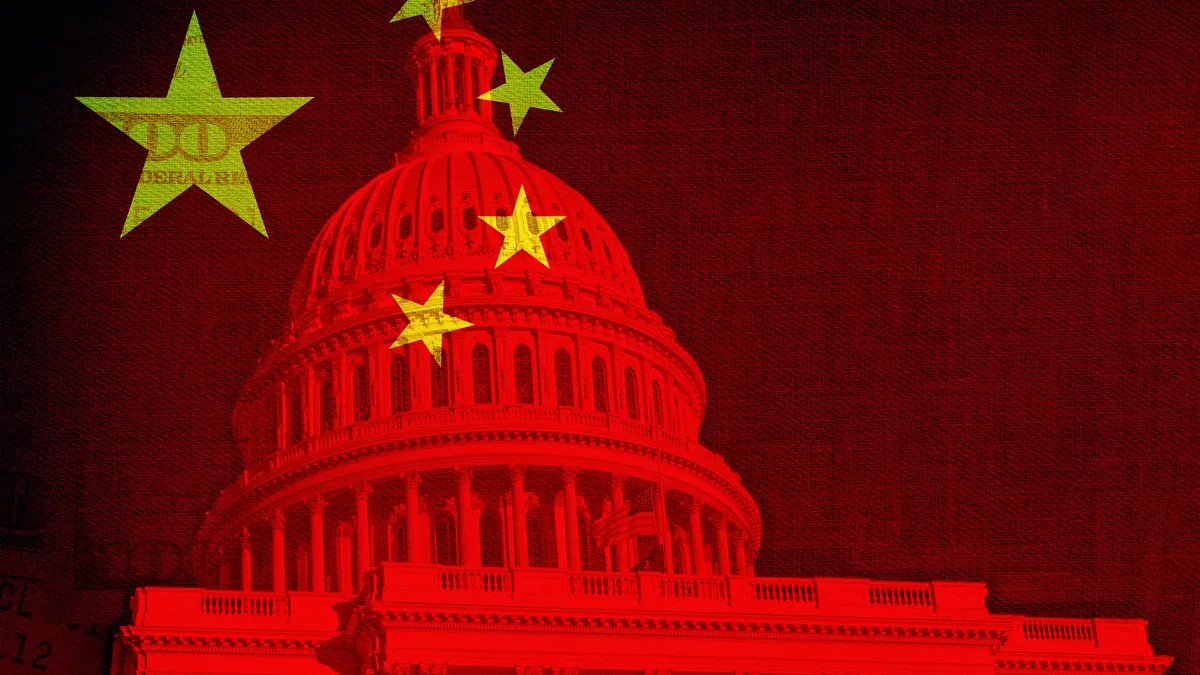
The Biosecure Act is back from legislative limbo. Last week, the U.S. House approved the initiative as part of the final National Defense Authorization Act, which is likely to be passed by the Senate and signed into law by the president this month.
The approved version of the Biosecure Act is slimmer than what lawmakers initially wanted, but the bill stays true to its original intent, pressuring companies to sever supply chain ties with certain Chinese firms to protect against national security risks. It also includes modifications intended to shield companies from unintentionally being swept into enforcement actions or hit with penalties.
“The latest Biosecure Act revision in the NDAA keeps the core idea — blocking U.S. federal money from flowing to risky foreign-adversary biotech firms — but softens and restructures how it works,” said Michael Abrams, managing partner at Numerof & Associates, in an email.
The new version changes how it defines those biotech firms. Instead of singling out five specific firms, including WuXi AppTech, Complete Genomics and MGI Tech, it will now rely on the Department of Defense’s 1260H list of Chinese military companies operating in the U.S., as part of a new process to identify “biotechnology companies of concern.”
The change was made because some legislators argued that identifying specific companies violated their due process rights, a sticking point that may have stalled passage last session. In a client alert, law firm Hogan Lovells notes that the Pentagon is expected to add WuXi AppTec to the 1260H list in its next update.
Under the Biosecure Act’s revised provisions, federal agencies, and grant and loan recipients can’t use equipment and services from 1260H firms.
Compliance timelines have also changed. Some U.S. companies may be granted a roughly five-year wind-down period for existing contracts instead of a flat eight-year window, Abrams said. In other situations, however, Hogan Lovells notes that the compliance timeline could be as fast as 60 days.
There’s also more wiggle room for U.S. companies that buy equipment from China. While the definition of banned biotech equipment under the revised rule remains broad, it drops some explicit mentions of certain items, including mass spectrometry and polymerase chain reaction systems, Abrams said.
“The new text adds clearer waivers, public-health emergency carve-outs, safe harbors for legacy products, and protections so Biosecure doesn’t accidentally disrupt Medicaid/Veterans Administration drug pricing,” he said.
In the earlier version of the bill, a U.S. company that supplied a product with components that originated in China could potentially lose the support of federal health programs. But a new provision protects companies if Veterans Affairs determines they would otherwise comply with federal supply rules.
Collaborations with China complicate compliance
The Biosecure Act heaps additional complications to an industry already grappling with deep and complex ties to the Chinese biotech sector.
Some companies began shifting away from China-based biotechs when the legislation was first introduced to avoid this challenge altogether. But reliance on Chinese companies, which make up 13% of global API manufacturers, is a costly and complicated habit to break. Making a shift to new sourcing could require regulatory approval, depending on how it affects the manufacturing process. Changing suppliers could potentially impact the composition of the drug product, which would require an amendment to the nNew drug application, according to Morrison Foerster.
Some companies are hoping to find a fix by reshoring to the U.S. or looking to other countries to source ingredients, such as Vietnam, Mexico and India.
But severing ties with China is getting even thornier as many companies look to Chinese biotechs to replenish their pipelines.
This year, Chinese companies became appealing pharma M&A targets, comprising 35% of announced deals in 2025, as the country’s innovation sector grows at a rapid clip.
China is also a hub for clinical trials. In 2024, China-based Jiangsu Hengrui Pharmaceuticals unseated the U.K.'s AstraZeneca as the top clinical trial sponsor in the world, according to Citeline’s 2025 annual Clinical Trials Roundup. China is earning a larger share of clinical research due to its ability to accelerate trials at a lower cost, while government policies and AI tools also fuel its rise.
As the Biosecure Act advances, pharma companies will need to have a solid understanding of their manufacturing process to identify potential risks, and should track changes to the legislation to determine how they might be affected. And overall, the industry will need to find a balance between collaborations with China to enhance U.S. drug development while protecting against national security risks — a substantial challenge in the years ahead.