Biogen is on a mission to transform — from building a new headquarters in Kendall Square near Boston to further expanding the aperture beyond its multiple sclerosis beginnings — and emerging technologies are set to be key players in that effort.
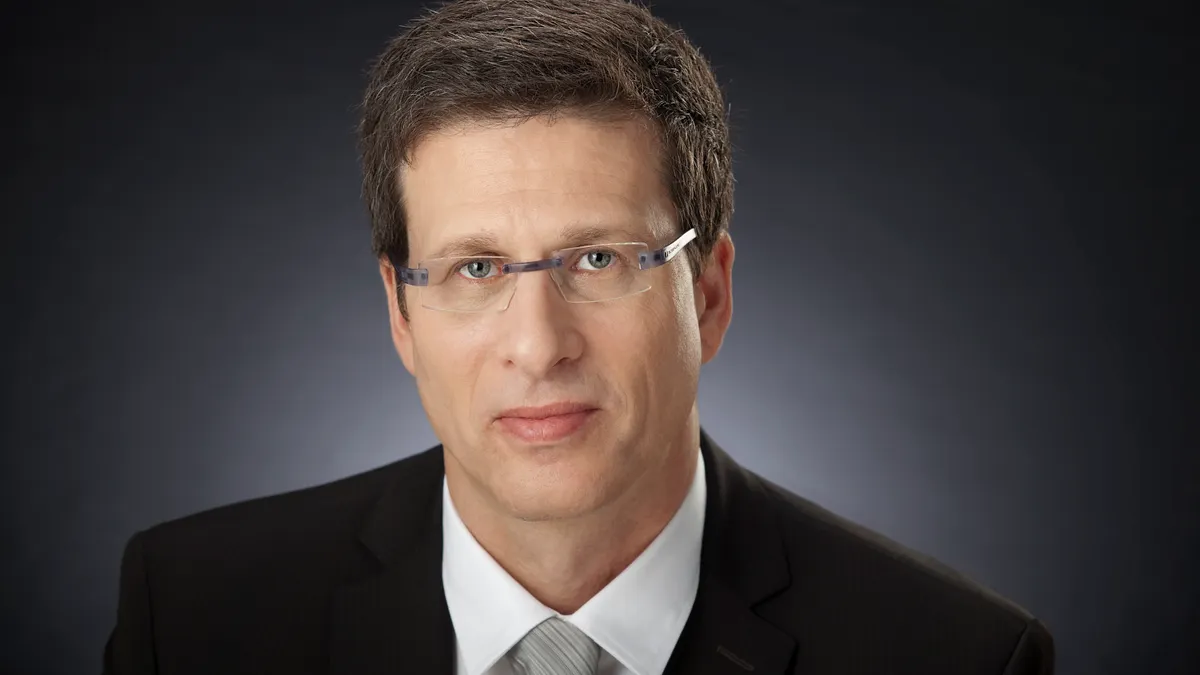
Spearheading the IT side of that overhaul is Guy Hadari, senior vice president and global chief information officer, who’s guiding the company in a way he hopes will set the stage for a new era of therapies. His approach isn’t to opt in to “dozens of Blue Sky pilots,” but to diligently and carefully assess which technology needs the company should pursue that are directly linked to business outcomes, he said.
Biogen has already established newer directions past the outsized success of its MS blockbuster Tecfidera, with the rare disease drug Spinraza and the Alzheimer’s groundbreaker Leqembi, as well as a series of partnerships with fellow biopharmas Genentech and Sage Therapeutics. And although 2025 was a relatively mediocre year when it comes to revenue, the company is building a nascent pipeline with blockbuster hopefuls of the next decade.
"The CIO is moving from the basement — where everything is being done but nobody sees or understands what IT is doing — to the front line."

Guy Hadari
SVP, CIO, Biogen
To get there, Hadari said Biogen will be integrating all aspects of the business with technology like revamped patient service platforms and cost-saving AI models. For Hadari, that means his role — like many CIOs in biopharma — is changing at a rapid clip.
Here, Hadari explains how his role has shifted, where the company is heading in the AI arena and how these new directions will serve Biogen’s trajectory in solving complex biological problems.
This interview has been edited for brevity and style.
PHARMAVOICE: How has the role of CIO changed over the last decade or so?
GUY HADARI: The CIO is moving from the basement — where everything is being done but nobody sees or understands what IT is doing — to the front line. And it’s not just because of AI. That’s just one wave. The CIO is becoming more visible because what they do is more critical to the evolution of a company. This is an evolution not just of the role but of the business understanding of the role. It used to be perceived as providing hardware and making sure PCs are working to now being run as a business. AI will push it even further, and then the potential for things like quantum computing will make the role of technology even more important in 20 or 30 years.
What is the “new Biogen,” and what is your role in shaping it?
Biogen is going through a massive change as a company. We are moving away from being a single-franchise, single-therapeutic-area company to taking on a diverse pipeline and multiple products across immunology, rare disease, Alzheimer’s and more. From a one-stem company to a tree. The real challenge there is that the company evolved over the last 25 to 30 years with designs, processors, technology and ways of working for a single franchise. Now, we are becoming a different company. And all those underlying processes need to support it.
I’ll give you an example: Our patient services center where we support patients starting from reimbursement and through the whole process is designed to support multiple sclerosis. Now that we need to support a diverse portfolio, we need to redesign those business processes. We are paving the new highways of the company, and if we didn’t do that, the changes that [CEO] Chris [Viehbacher] wants to drive could not take place. We started this process two years ago, and we have two to three more years to go. This is a big step, and we work hand in hand with the business to adopt and define these new processes.
What have you accomplished in those two years?
The first area we addressed was R&D because we are heavily focused on development. Biogen’s development systems, from a technology perspective, were a result of 30 years of tailored investment, and we’ve replaced that with one integrated system that is industry standard. We’ve done the same for quality systems in manufacturing and the patient services platform, which we’re still working on. We still have things to do in development and manufacturing, and in commercial, and I would say 2026 to 2027 it will be done. That fits very nicely with our pipeline evolution and readouts.
As you integrate these new systems, you’re introducing more AI. Broadly speaking, as pharma pans for gold in the AI space, what do you think are the nuggets that will stand strong?
AI is the new kid in town, but it’s not the first kid. We’ve had digital and dot-com. This kid is different, though. I’m a skeptical, careful guy, and I think there is important promise for pharma, but we have to set up our expectations. A study from MIT found that 95% of AI projects fail. I’m a little skeptical of that number, but I’m sure it’s high, and there are plenty of reasons, like unrealistic expectations and chasing technology.
I don’t chase technologies. I chase outcomes. We know very well what technology is out there, don’t get me wrong. We keep our eyes and ears open. But if I can’t see a well-defined outcome, preferably linked to revenue or cost, I’m very skeptical. So I tell people, don’t tell me about technologies. Tell me about the problem and the expected outcome. I don’t want to get stuck in proof of concept land. And as for AI in drug discovery, the jury is still out. I think it will take years longer than what was expected. Quantum computing will be another jump, but that’s also years down the road.
At Biogen, we break AI into a pyramid. At the foundation is the table stakes, like [Microsoft’s] Copilot and agentic AI that we’ve already implemented because you need to start changing people’s way of thinking. AI is not just technology and products — it’s also culture. So that’s baseline. In the middle of the pyramid are tactical projects, an example being the painful, lengthy, expensive process of due diligence in the case of an acquisition. For our acquisition of HI-Bio [in July 2024], instead of reviewing thousands of contracts at high cost for three to four months, we fed the model and in 10 hours we’re on our way. The third layer is strategic bets, and this gets into the R&D world. It takes two years just to develop the regulatory documents required during the life cycle of drug development. If we can cut that time in half, we gain another year of the product on the market, and for us and the patients, that’s a game changer. We’ve done a pilot, and we want to develop our muscles here more.
Biogen is at the forefront of some very complex and difficult science. What’s the importance of your role in getting to that next level of targets and treatments in areas like Alzheimer’s, for instance?
A lot of value sits with the different types of data we have and how we use it. In Alzheimer’s, there’s a ton of data, especially for biology, and getting a sense of this data in a way that can help us in development and help patients is a monumental task. It’s a task that neither the business nor IT can do alone, and it touches everything. We have data from R&D, from manufacturing, from finance, from commercial — and IT’s main job is to integrate the stakeholders and the discussion around an agenda like Alzheimer’s and take it to action. That is the gold, and it’s easier said than done. Our team is at the center because we’re the only ones who can bring everyone to the table. We see everybody. We’re in a good place for that kind of journey.
Our hands for the next two and a half years are completely full, with the AI agenda, the data agenda and the growth of the company. I want to allow Biogen to fulfill its strategy, and if [the IT team] doesn’t do that, we will be inhibiting its success. So our agenda is very clear.